

Opencals vs Zenoti - which booking platform is right for your service business
Opencals and Zenoti both serve service businesses, but they aim at different scales and solve different problems. Which one fits depends mostly on how complex your booking rules are, how big you are, and how much you want to spend upfront.
Zenoti sells itself as an all-in-one operational suite for multi-location, enterprise-scale service businesses. Opencals is booking infrastructure: it runs as a standalone platform, but it can also plug into systems you already have through its API.
$1/booking
Opencals entry pricing
Custom
Zenoti typical pricing
Minutes
Opencals setup time
Weeks
Zenoti implementation typical
Pricing structure and cost models
Opencals starts around $1 per completed booking with full platform access and no long-term contract. As your volume grows, you can switch to a fixed monthly plan scaled by locations, staff, and advanced features. You pay in proportion to what you're actually taking in, so there's little to lose by trying it.
Zenoti runs on custom enterprise pricing. There's no public price list; you go through a sales consultation. Industry estimates put it at $200–$600+ per location per month, plus implementation and onboarding fees. That model assumes multi-location deployments and longer sales cycles, which makes it awkward for a startup or a solo operator just testing the market.
Note
At the small end the gap is real. A single-location salon might pay $1–$5 per day with Opencals ($30–$150 monthly); Zenoti typically starts at $200–$300 monthly regardless of booking volume.
Core booking and scheduling capabilities
Both platforms handle appointment scheduling, but they model availability differently based on their target use cases.
Opencals calculates openings on the fly from staff schedules, location hours, service rules, capacity limits, and other constraints, all at once. That lets it handle harder scenarios: multi-staff appointments, variable-duration services, rentals, group bookings, capacity-based services, and multi-day reservations. A service can depend on a specific staff member, a specific location, a specific resource, or any combination of the three.
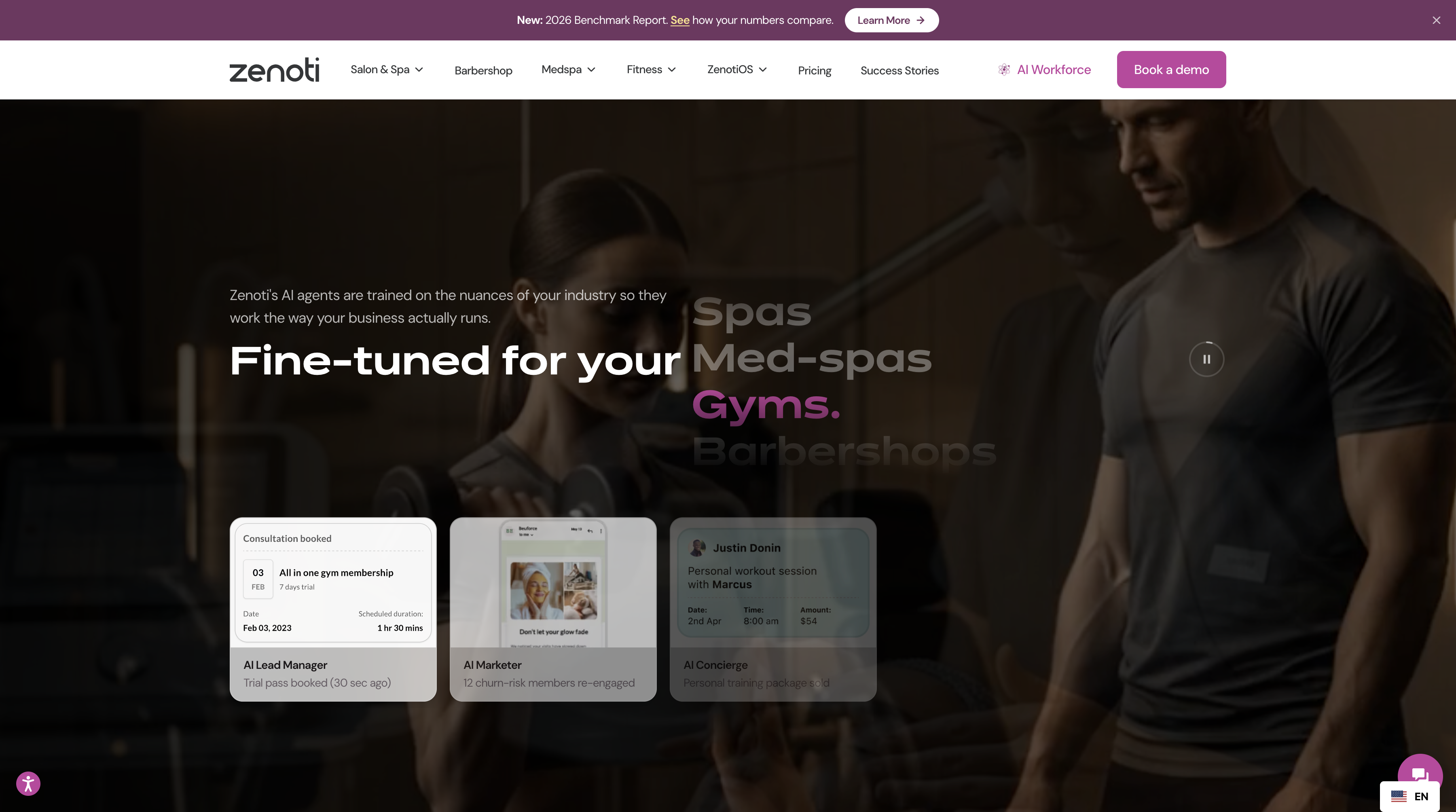
Zenoti focuses on traditional appointment scheduling for salons, spas, and fitness studios. Its calendar-based approach works well for fixed-duration services assigned to one staff member in a room. The booking logic is hierarchical: customer selects a service, the system shows available staff, the customer picks a time. That's smooth for standard spa workflows but gets cumbersome for multi-staff appointments, equipment-dependent bookings, or pricing that varies with availability.
Tip
Zenoti strengths in scheduling:
- Drag-and-drop staff scheduling interface
- Built-in room and equipment management
- Visual calendar for front-desk staff
- Multi-location calendar synchronization
Opencals strengths in scheduling:
- Dynamic availability across multiple constraints simultaneously
- Rental and resource-based booking models
- Variable-duration services (minutes, hours, or multi-day)
- Group bookings and multi-attendee support
- Flexible capacity rules and waitlist handling
Features and operational capabilities
| Capability | Opencals | Zenoti |
|---|---|---|
| Online booking storefront | ||
| Multi-location management | ||
| Staff scheduling | ||
| Point-of-sale (POS) | ||
| Integrated payments | ||
| Recurring bookings | ||
| Group bookings | ||
| Rental/resource-based bookings | ||
| Membership and subscriptions | ||
| Marketing automation | ||
| Payroll management | ||
| Inventory tracking | ||
| Developer API | ||
| White-label option | ||
| AI-powered setup |
Zenoti's operational breadth covers built-in POS, payroll, inventory, and marketing automation. If you want one platform for bookings, point-of-sale, staff payroll, and email marketing, Zenoti gives you all of it in one place. Fewer tools to switch between, but you may also be paying for features you don't use.
Opencals' focus is narrower and deeper: it's built around the booking lifecycle, with payments, customer records, and order management all tied to it. There's no payroll or inventory. What it adds instead is a developer API and white-label capabilities, so you can embed booking logic into other systems or build your own operational suite around it.
Integrations and extensibility
Zenoti integrates with the usual SaaS tools like Mailchimp, Zapier, and basic calendar sync. But it's designed as a self-contained solution: most workflows are meant to happen inside Zenoti rather than across external tools.
Opencals takes a different approach. The platform includes:
- Shopify integration for selling appointment-based products alongside retail items
- Developer API for custom integrations and data synchronization
- White-label deployment for agencies and resellers
- Calendar integrations for syncing meetings and availability
- Webhook support for custom automation
This makes Opencals a better fit if you want to embed booking into an existing ecosystem, or if you're an agency building solutions for multiple clients.
Opencals API architecture
Build custom integrations, migrate data from legacy systems, or embed booking logic directly into your website or application.
Industries and use cases
Zenoti is best suited for:
- Salon and spa chains
- Medspas and aesthetic clinics
- Fitness studios with class scheduling
- Barbershops and personal grooming franchises
- Multi-location beauty and wellness brands
Zenoti is strongest in industries with predictable, standardized workflows. A hairstylist books a 60-minute slot with a specific stylist in a specific chair, and Zenoti handles that elegantly.
Opencals is best suited for:
- Equipment and tool rentals
- Tours and activity bookings (multi-day, varying group sizes)
- Personal training and fitness coaching
- Classes and workshops (with variable group sizes)
- Medical and therapeutic practices
- Event coordination and venue management
- Professional services (photography, consulting, training)
- Salon and spa businesses (just like Zenoti)
Opencals is strongest where the booking rules are complex. A photography session might need the photographer, the studio, a specific camera, and a second assistant, each with its own availability. Opencals computes that; on Zenoti you'd coordinate it by hand.
Warning
Business size and scalability
For solo operators and small businesses:
Opencals' $1-per-booking model is far cheaper here. A solo stylist taking 10 bookings a week pays roughly $40–$50 a month. The same operator on Zenoti pays $200–$300 minimum, even at that volume.
For growing SMBs (2–5 locations):
Both platforms support multi-location operations, but the cost curves differ. Opencals scales incrementally; Zenoti often jumps in bigger steps. At this size Opencals still costs less while giving you more flexible booking logic.
For enterprise and franchise operations:
Zenoti gets more competitive at high scale because of the all-in-one feature set: payroll, inventory, marketing, analytics. If you need centralized payroll and marketing automation across 50+ locations, that integrated suite cuts down on tool sprawl. That said, some large operators prefer Opencals' API-first approach precisely because it lets them wire booking into their own systems.
1
Typical minimum locations for Zenoti
Unlimited
Opencals locations (any plan)
Scalable
Opencals cost model
Fixed+variable
Zenoti pricing structure
Implementation and setup time
Opencals uses AI-powered configuration wizards, so you can go live in minutes. Sign up, set up services and staff schedules through conversational AI, and publish a booking page within an hour. No implementation team needed.
Zenoti usually means weeks of implementation, data migration, staff training, and onboarding consultations. It expects upfront planning and often includes migration support from legacy systems. That fits its enterprise positioning, but it's a lot of friction for a smaller business that just wants to try the platform.
If you need to launch fast, especially to test demand, Opencals is much quicker. If you have dedicated IT resources and want hands-on implementation support, Zenoti's managed onboarding may suit you better.
Customization and white-label options
Opencals offers true white-label capabilities. Agencies and resellers can embed Opencals booking logic into their own platforms, rebrand it completely, and deliver booking systems to clients under their own name.
Zenoti has no white-label option. Every deployment is branded as Zenoti, which rules out most reseller and agency use cases.
So if you're an agency wanting to offer booking to multiple clients under your own brand, Opencals is really the only option of the two.
Strengths and limitations
Pros
- Enterprise-grade operational suite
- Strong multi-location management
- Integrated POS and payroll
- Built-in marketing automation
- Comprehensive analytics and reporting
- Well-suited for salon and spa workflows
Cons
- Custom pricing (higher entry barrier)
- Long implementation timelines
- Less flexible for non-standard booking models
- Higher minimum cost for small businesses
- No white-label option
- Steeper learning curve for small teams
Zenoti's limitations show up when your booking logic doesn't fit the standard "service → staff → time slot" model. Multi-resource bookings, variable pricing, or complex capacity rules end up as manual workarounds or configuration that fights the platform.
Opencals' limitations are in operational breadth. No payroll, no inventory, no email marketing automation. If you want one system for everything, you'll be integrating Opencals with other tools. For a lot of businesses that's actually the point: you pick best-of-breed tools instead of accepting Zenoti's bundled, sometimes less specialized ones.
Key use case comparison
Choose Zenoti if:
- You operate multiple salon/spa/fitness locations
- You need integrated payroll and staff management
- Your booking model is standardized (service → staff → time)
- You want all-in-one operational management
- You have dedicated IT resources for implementation
Choose Opencals if:
- You need flexible, complex booking rules
- You want to minimize upfront costs and implementation time
- You require resource-based or rental bookings
- You operate across different business models (not just standard appointments)
- You want to embed booking into your own brand or system
- You're a solo operator or small team testing market fit
- You need an API-first platform for custom integrations
Scalability considerations
Both platforms scale to high booking volumes and multi-location operations, but they scale differently.
Opencals scales flexibly. You start at $1 per booking, move to a fixed monthly plan as volume grows, and add locations and staff without hitting tier jumps. Any plan handles unlimited locations and staff. Costs grow along with the business.
Zenoti scales in steps. Fixed per-location pricing makes adding a location predictable, but each one usually means a sales conversation and a contract adjustment. It's built for planned, large-scale operations rather than gradual growth.
If your business grows unpredictably or seasonally, Opencals' flexibility helps. If your growth is steady and planned across known locations, Zenoti's fixed pricing may be easier to forecast.
Get started
Ready to transform your service business?
Join 150+ businesses already using Opencals. Start on a free development store with every feature unlocked, and only pay once you go live.