

Opencals vs. Mindbody: which booking platform is right for your business

Both Opencals and Mindbody solve the core problem of managing service bookings at scale, but they approach it differently. Mindbody built its reputation in the fitness and wellness space, while Opencals was designed as infrastructure for any service business that needs to model complex operational rules.
$1
Opencals usage-based starting point
$99+
Mindbody starter plan minimum
2+ locations
Where costs diverge most
Pricing: pay-as-you-grow vs. fixed monthly commitment
Opencals and Mindbody price on opposite models, and the gap widens as you add locations.
Opencals pricing starts with usage-based billing at approximately $1 per completed booking, with full platform access included. There is no minimum monthly charge, no setup fee, and no long-term commitment. As your booking volume grows, you can transition to fixed monthly plans based on operational factors like number of locations, staff members, and advanced features. A solo therapist booking 10 appointments per month pays $10; a 5-location fitness franchise booking hundreds per month may pay a fixed fee that works out cheaper per booking.
Mindbody pricing follows a tiered subscription model with mandatory monthly fees per location. Entry-level plans start around $99–$159 per month per location for basic scheduling and payments. Mid-tier Accelerate plans run $259–$279 per month per location, adding analytics and marketing automation. Premium Ultimate plans cost $349–$699+ per month per location. On top of that, Mindbody charges transaction fees for payment processing and may apply separate costs for branded mobile apps or marketplace bookings.
For a small business starting out, Opencals' usage-based model is significantly cheaper — you pay nothing until you have actual bookings. For established multi-location businesses with predictable high volume, Mindbody's fixed pricing may offer better value per booking. But because Opencals scales into fixed plans too, the cost advantage tends to hold even at higher volumes.
Tip
What comes out of each payment
Mindbody processes payments through its own system. A third-party cost breakdown (Fitbudd, 2026) reports 2.99% + $0.30 for card-present payments and 3.60% + $0.30 for online and keyed-in ones, plus a 20% commission, capped at $30 a transaction, on clients who arrive through its marketplace. I couldn't find those rates on Mindbody's own pages, so check them against your quote.
Opencals adds no fee on Stripe payments. Each merchant connects their own Stripe account, the charge is made on that account, and our payment code sets no application fee, so Stripe's own rate (2.9% + 30¢ on domestic online cards in the US) is the whole processing cost.
Take $50,000 of online card sales across 300 bookings in a month, an average of about $167. Stripe's standard rate comes to $1,540. Mindbody's reported online rate comes to $1,890. The $350 difference is $4,200 a year, before the subscription.
Core booking and scheduling features
Both platforms handle the fundamentals of appointment scheduling, but they differ significantly in what "scheduling" actually means under the hood.
Opencals models scheduling as a computational problem. It calculates availability dynamically based on staff schedules, location hours, service duration, capacity limits, required resources, and custom business rules all at once. This means you can support complex scenarios without workarounds: a personal trainer who works across two locations with varying availability, a rental business with multi-day reservations, a class-based service with group bookings and waitlists, or a beauty salon where certain services require multiple staff members simultaneously.
Mindbody provides straightforward scheduling optimized for the wellness and fitness industry. You define services, class times, staff assignments, and pricing, then the system manages bookings through a calendar interface. It handles single appointments, recurring classes, memberships, and packages well. But if your business requires non-standard booking logic — services with variable duration, resource-dependent availability, or complex multi-staff dependencies — you'll likely need manual management or workarounds.
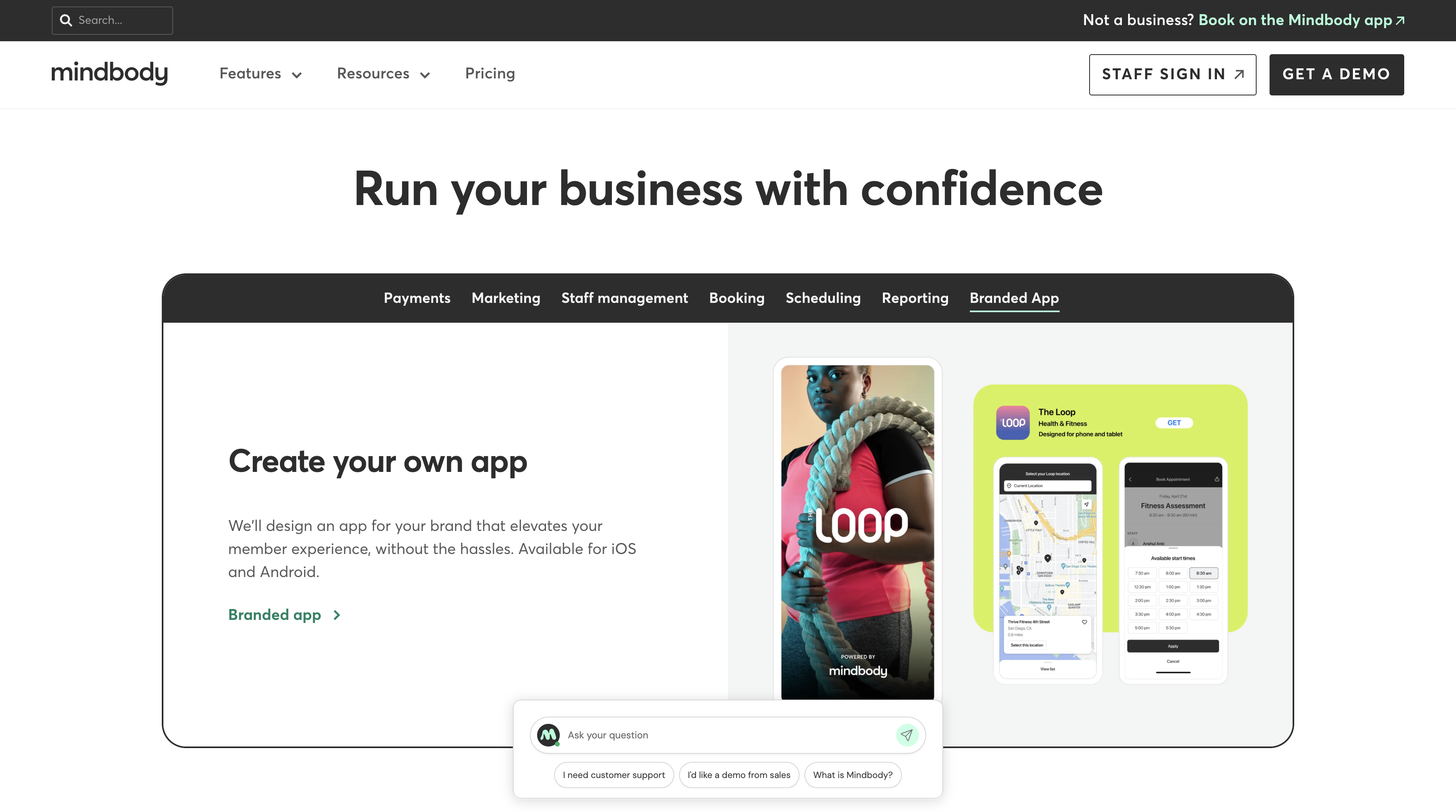
Customer-facing booking portals differ in philosophy. Opencals provides a customizable, branded booking experience that you can embed or deploy independently. Mindbody offers both embedded widgets and access through its consumer marketplace app — this marketplace exposes your business to millions of potential customers but also binds you to Mindbody's ecosystem.
| Feature | Opencals | Mindbody |
|---|---|---|
| Dynamic availability calculation | ||
| Multi-location support | ||
| Staff scheduling with rules | ||
| Group bookings and capacity | ||
| Recurring services | ||
| Custom booking logic | ||
| Consumer marketplace | ||
| Branded booking portal |
Integrations and extensibility
Opencals is built as infrastructure first, application second. It provides a REST API and webhooks, so developers can build custom integrations or embed booking logic into websites, apps, or third-party systems. The platform supports calendar integrations (Google Calendar, Outlook), payment processors, and e-commerce platforms like Shopify. Because Opencals models bookings as structured data with clear operational rules, integrations tend to be more flexible and less prone to edge cases.
Mindbody offers integrations through a developer API and third-party app marketplace, but the ecosystem is smaller and primarily focused on wellness-adjacent services. Its integrations work well within the wellness industry — connecting to gym management, payroll, or marketing tools — but extending Mindbody to non-traditional service verticals often requires workarounds. Payment processing is integrated but includes Mindbody's transaction fees.
Opencals has native Shopify integration for appointment-based products, which makes it a strong fit if you sell services through a Shopify store. Mindbody does not have this level of e-commerce integration.
Developer API and extensibility
Opencals' API-first architecture allows custom integrations and embedded booking logic. Mindbody's integrations are strong within wellness but limited outside that vertical.
Industry fit: where each platform excels
Mindbody is purpose-built for the wellness and fitness industry. If you run a yoga studio, CrossFit gym, spa, salon, or personal training business, Mindbody has pre-built workflows tailored to your needs. Class management, memberships, recurring packages, client profiles with visit history, and marketing automation for retention are all optimized for this market. The consumer marketplace is a real advantage too — millions of people search for fitness and wellness services through Mindbody's app, which gives you a built-in customer acquisition channel.
Opencals is designed for any service business that needs operational flexibility. That includes traditional wellness businesses but extends to rentals, tours, professional services, event management, education platforms, medical practices, and anything else where services have complex operational dependencies. If your business model does not fit neatly into the "class-based fitness" category, Opencals is likely the better choice.
Note
Business size and scale considerations
Opencals scales efficiently across business sizes. A solo freelancer pays $1 per booking with no overhead. A 50-person team across 10 locations manages everything through the same system at a fixed monthly rate based on scale factors. The pricing model removes friction at every stage of growth.
Mindbody requires fixed monthly commitments per location from day one. For a single-location business, this is manageable. For a franchise or multi-location operation, costs compound quickly — a 5-location business might pay $500–$3,500+ per month depending on plan tier, regardless of actual booking volume. That makes Mindbody less attractive for businesses in rapid growth or seasonal variation phases.
Multi-location management works differently. Opencals treats multi-location as a unified system where you manage staff, services, and schedules across locations from a single dashboard with location-specific rules applied automatically. Mindbody requires separate management per location in many workflows, though it does provide consolidated reporting.
Strengths and limitations
Pros
- Usage-based pricing removes adoption barriers
- Dynamic availability handles complex booking logic
- Designed for any service vertical
- Comprehensive API for custom integrations
- Scales cost-efficiently to large operations
Cons
- Smaller ecosystem compared to Mindbody
- Less pre-built marketing automation
- Consumer discovery through marketplace not available
- Steeper learning curve for advanced features
Mindbody strengths:
- Optimized workflow for fitness, wellness, and beauty industries
- Built-in consumer marketplace for customer acquisition
- Comprehensive marketing automation and client retention tools
- Large established ecosystem with wellness-focused integrations
- Intuitive interface for simple appointment-based models
Mindbody limitations:
- Expensive for businesses with low or seasonal booking volume
- Difficult to model non-standard operational requirements
- Scaling to multiple locations increases costs significantly
- Less flexible for service verticals outside wellness
- Fixed monthly commitment creates friction for startups
When to choose Opencals
Choose Opencals if you need any of the following:
- Complex operational requirements: Variable service durations, multi-staff dependencies, resource-based availability, or custom booking logic.
- Multi-location efficiency: You want to manage multiple locations from one system without per-location costs compounding.
- Flexible pricing model: You prefer pay-as-you-go or need to minimize costs during startup or seasonal periods.
- Service verticals beyond wellness: You operate in rentals, education, professional services, tours, events, or healthcare.
- Custom integrations: You need to embed booking logic into your website, app, or third-party platforms via API.
- Shopify integration: You sell appointment-based services through a Shopify store.
When to choose Mindbody
Choose Mindbody if you need any of the following:
- Wellness industry optimization: You run a fitness studio, yoga studio, spa, or salon where industry-specific workflows matter.
- Consumer marketplace access: Customer acquisition through Mindbody's app is valuable for your business model.
- Pre-built marketing automation: You want retention campaigns, referral programs, and automated messaging tuned to wellness businesses.
- Established ecosystem: You value integrations with wellness-focused tools and a mature community of users.
- Simple, straightforward scheduling: Your business model fits standard appointment and class structures without customization needs.
Get started
Ready to transform your service business?
Join 150+ businesses already using Opencals. Start on a free development store with every feature unlocked, and only pay once you go live.