

Playtomic alternative: running court booking on your own site

If you run a padel club in Europe, you are probably on Playtomic, and you probably didn't agonise over the decision. It's where the players are. Nearly every alternative gets compared to it rather than the other way round.
This isn't a piece arguing you should leave. It's the piece I'd want if I were a club owner looking at my own website and wondering why the most valuable page on it — the one where money changes hands — looks and behaves like it belongs to another company. Because it does.
Playtomic sells two different things: a player network you can't replicate, and club software you can. If your bookings come from players discovering you in the app, stay. If they come from members who already know you, moving the booking page onto your own site is worth doing — and you can see what that looks like in VOLT, a free MIT-licensed padel template.
Two products under one name
Conflating them is how clubs end up comparing the wrong things.
The first is the player network: an app where players find courts, find opponents, join open matches, and track a level that follows them between clubs. Playtomic claims over 6,700 clubs on it. That network is genuinely hard to build and there's no software you can buy that replaces it. If a member of yours plays on Tuesday because the app found them a fourth, Playtomic earned that booking and no template is going to.
The second is Playtomic Manager, the club software — scheduling, customers, payments, reports, a POS. This is the part that has competitors.
Two details from their own published material are worth knowing before a sales call (both checked 20 September 2026). Their pricing page lists four tiers — Standard, Professional, Champion, Master — with no prices on any of them; every button says "Get started" and the page ends in a request-info form. And API integrations appear only from the Champion tier upward, which is the third of four. Separately, players booking through the app pay Playtomic a service fee on top of the court price. Playtomic says the amount "will vary depending on the country and currency," and it isn't refunded if the player cancels their reservation.
I can't tell you what a Champion plan costs, because they don't publish it. That is itself a thing to know when you're budgeting.
The trade every marketplace booking page makes
None of what follows is Playtomic doing something wrong. It is what a marketplace is. A platform that finds players for you has to be organised around the player rather than around any one club, and both columns below fall out of that.
Pros
- Players who have never heard of you can find you and book you
- Open matches and levels fill courts you would not have filled yourself
- The booking page, the app and the payment rails are somebody else's to run and keep up
- A club with no website at all is taking online bookings the same afternoon
Cons
- Your page is an entry in a directory of clubs, on the platform's domain and under its navigation
- Nearby clubs — your competitors — are listed on it
- The platform's own promotions run there: sidebar slots, app-download prompts, wallet offers
- Your brand is content inside the frame rather than the frame itself
- Durations, cancellation windows, checkout questions and what you may sell beside a court are set by the product and by your tier
- The funnel prefers the app, where the platform controls the whole experience
Everything in that right-hand column is a fair price for distribution you would otherwise have to buy. It stops being a fair price on the bookings you brought in yourself — the member who typed your club's name into Google and landed on a page listing nine other places to play.
A white-label iframe is still someone else's page
To Playtomic's credit, they do document putting booking on your own domain. Their Manager help article on embedding your booking page tells you to drop in an <iframe> pointing at a white-label URL shaped like playtomic.io/wl/{tenant_id}, and warns that your configured site URL has to match the origin exactly — same protocol, same domain, www or not — or it won't work.
That solves the address bar. It doesn't solve the page.
An iframe is a second document living in a rectangle on your first one. Practically, that means the booking flow uses their components and their layout, not yours; it inherits none of your CSS, so your typeface and colours stop at the frame's edge; it scrolls independently, which on a phone is the thing players actually complain about; and you cannot add a field, reorder a step, or put anything of your own inside it. Your site becomes a frame around their product.
For a lot of clubs that's a perfectly reasonable trade. For a club that spent real money on a brand, or one selling more than court time, it starts to chafe.
The same booking, on your own page
Start with what you don't give up, because that's the part people assume they're trading away.
Opencals runs the booking engine as a hosted service behind a public API: availability, durations, capacity, orders, payments, invoices, customer accounts. The court grid a padel player expects is all there — every court down the rows, the day across the top, live availability, a duration picker that prices each option as they hover it. Slots are computed server-side, so you can't sell the same court twice.
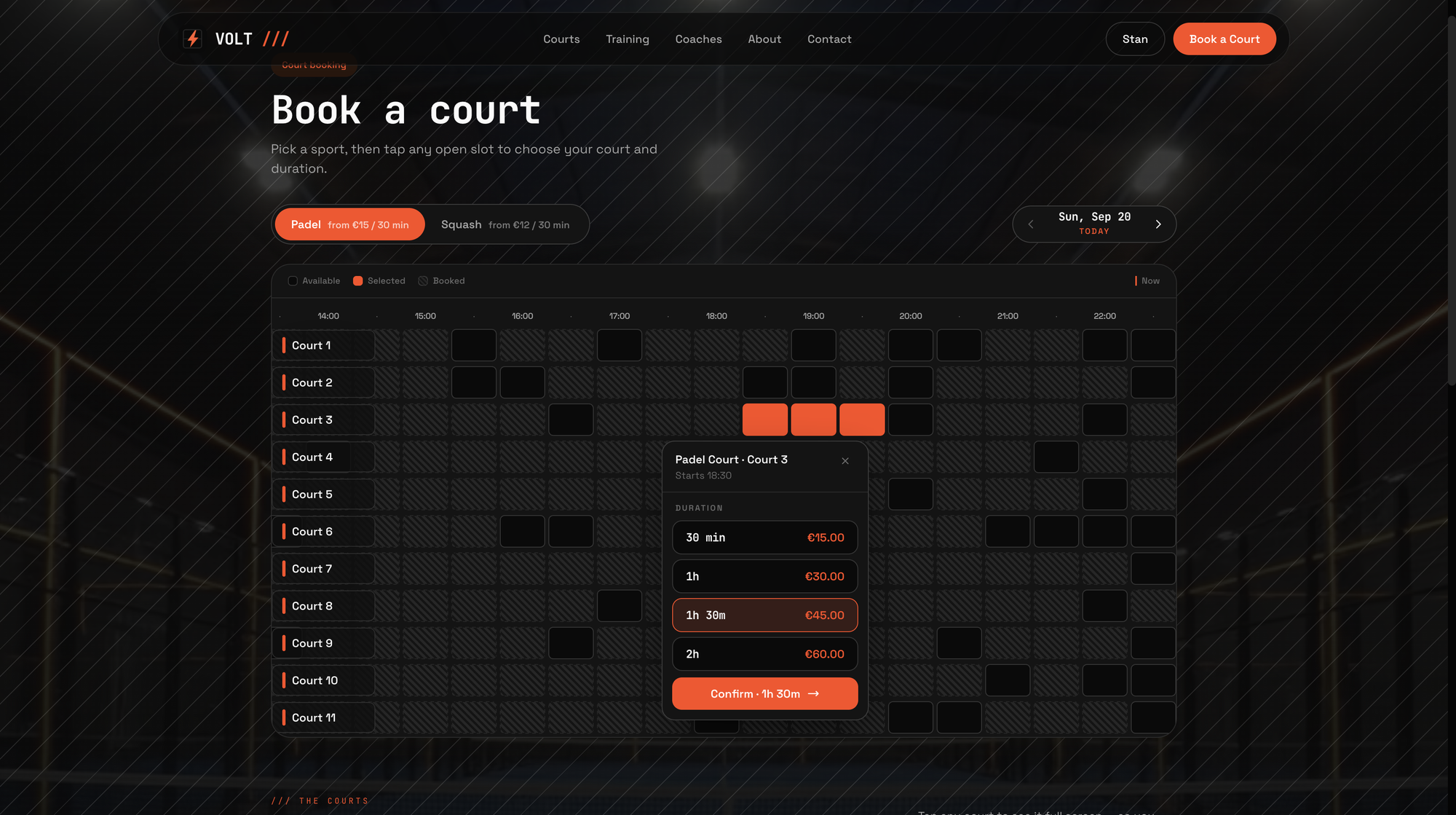
That's VOLT, the free MIT-licensed padel template, running on its own domain. Same calendar, same job, none of it your code to maintain — and nothing on the page you didn't put there. No other clubs, no promotions you didn't choose, no navigation pointing at a vendor's sales page.
The practical difference is that it's a page rather than a window. Your components, your design tokens, your typeface, your header and footer. It doesn't scroll inside itself, doesn't need an origin matched to anything, and doesn't stop looking like your site halfway down. On a site you already have, this is a new route in the app you already run.
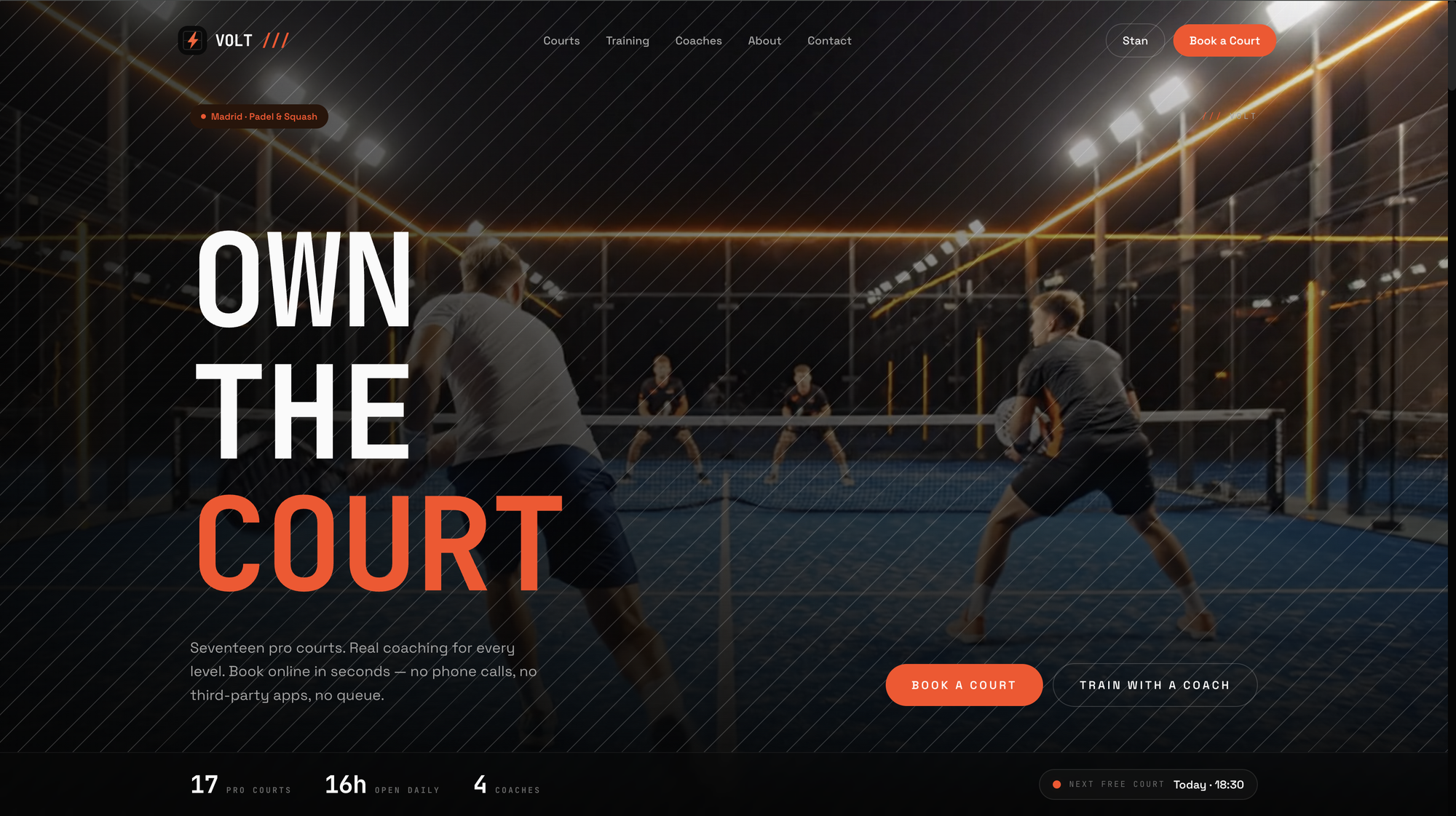
Then there are the things a framed page can't do at all.
You can sell things alongside the court. Every booking in Opencals is an order, so add-ons attach at checkout: racket hire, a tube of balls, a towel, a coaching add-on on top of a court rental. That's the difference between a reservation system and a shop, and it's where the revenue per booking moves.
You can ask your own questions. Checkout questions are configured in the dashboard and saved onto the appointment — "how many players?", "do you need rackets?", "first time at the club?" — and they show up inside your flow because the flow is yours.
You can implement your own rules. Peak pricing, a 60-minute cap on Saturdays, 45-minute squash slots, members-only windows, deposits, a different cancellation policy for members than for walk-ins. In VOLT the duration logic lives in a single use-court-grid hook, so a rule change is an edit in a file you own rather than a support ticket asking whether the feature is on your plan.
And you can go past what the grid does. Because the booking is an order rather than a calendar entry, the things clubs usually ask for next are already modelled: discounts and promo codes, deposits, invoices after the fact, multiple venues under one account. You are building on a commerce backend, so the ceiling is your own roadmap rather than a feature request queue.
| Playtomic | Opencals | |
|---|---|---|
| What it fundamentally is | A player marketplace with club software attached | A commerce backend with a public API |
| Booking on your own domain | White-label iframe at playtomic.io/wl/… | Your own pages, your own components |
| Player discovery & matchmaking | Yes — the core product | No, and not planned |
| Add-ons and upsells at checkout | Not in the embedded flow | Yes — every booking is an order |
| Published pricing | None — four tiers, request info | $14.98/mo incl. 300 bookings, then $0.20 each |
| API access | From the Champion tier upward | Included, public docs |
| Free starting point | Not published | Dev Store in test mode + MIT templates |
The account comes before the booking
Playtomic's own booking instructions start at step one with "Open the Playtomic app and navigate to your favorite club's profile," then the Book tab, then date and court, then payment. Creating an account is a separate help article.
That's not sloppiness on their part — it's structural. The account is the product. Levels, match history, the fourth player who joins your game: none of that works anonymously, so the account has to exist before the booking does.
On your own site you get to decide where that gate sits, or whether there's one at all. In VOLT the player picks a slot, chooses add-ons, answers whatever you asked, pays, and is signed in afterwards — the account is created from the checkout details they were already typing, and the six-digit email code only matters the next time they come back. Require registration up front if you want it; most clubs shouldn't.
To be straight about it: the player still ends up with an account either way. Nothing here is anonymous guest checkout. The difference is ordering, and ordering is most of what conversion is — asking someone to register before they know whether Tuesday at 19:00 is even free is a request for commitment before you've given them anything.
If you already have a site you like
You don't need the template. The booking page becomes a route in the app you already run, talking to the Storefront API through the typed SDK — VOLT is then a reference implementation rather than a starting point. It is still developer work; it just isn't a rebuild, and nothing about your existing design has to change to accommodate it.
The part where a template loses
I'd be doing you a disservice by stopping there, so here's the other column honestly.
Matchmaking is the real moat and we don't have it. No open matches, no player levels, no results, no cross-club discovery. Opencals has no plans to build a consumer network, and a club whose occupancy depends on strangers finding each other should not read this article as permission to churn.
Nor do we have the install base. A player with the Playtomic app already on their phone will book through it. Your beautiful own-brand page has to be found first.
There's no waitlist. If your 19:00 courts are full, Opencals shows them as booked and the interaction ends. For a club that's the single most valuable slot of the week and the most obvious gap in what we offer. It's the thing I'd fix next.
Opencals is not open source. The templates are MIT and the SDK is on npm; the platform behind them is a commercial hosted product and the engine isn't being open-sourced. You own the frontend, you rent the backend.
And the free tier can't take real money. A Dev Store runs in test mode. It exists so you can build the whole thing and show it to your partners before paying anything, not so you can run a club on it.
Also worth saying: Playtomic Manager does club-operations things we don't. A POS, memberships, leagues, tournaments, campaigns — those sit on their upper tiers and if your club runs leagues every week, that's a real reason to stay on a platform built for it.
What it costs to find out
You can build the whole thing for free and decide afterwards, which is the only reason I'd suggest spending an evening on it at all.
Deploy the padel template
VOLT is a free MIT-licensed padel & squash club site — court booking grid, coach-led training, checkout, player accounts. One-click deploy to Vercel, seeded with a demo club's courts and coaches so it renders fully populated rather than empty.
Rebrand it in one file
lib/site-config.ts holds every piece of club-specific copy; app/globals.css holds the colour and type tokens. Put your club's name, sports, coaches and palette in and you have a real preview of your own site.
Decide with something in front of you
Show it to whoever signs off. Compare it against your current page and your current fees, and switch a live store on only if it wins. Test mode costs nothing either way.
VOLT — the free padel template
Court grid, coaching, checkout and accounts. MIT licensed, with a live demo.
VOLT on GitHub
The source. Clone it, fork it, or deploy it straight to Vercel.
The Storefront API
Auth, endpoints and examples for building booking into your own app.
Opencals pricing
$14.98/mo including 300 bookings, then $0.20 each. Dev stores are free.
The arithmetic you can check yourself
Court clubs do volume that appointment businesses don't, and that changes which pricing model wins. Worth doing the sums before anyone gets attached to anything.
Take a six-court club open fourteen hours a day, selling mostly 90-minute slots, running at 60% occupancy — roughly 34 bookings a day, a bit over 1,000 a month. Substitute your own numbers; the shape is the point, not my guesses.
~1,000
bookings/month — 6 courts, 14h days, 90-min slots, 60% full
$160
Opencals Custom plan at that volume
not published
Playtomic's equivalent — four tiers, a contact form
That club belongs on the Custom plan: $14.98/month covering the first 300 bookings, then $0.20 each with no tier jumps. The pay-per-booking Elastic plan at $0.99 would be over $1,000 for the same month — it exists for businesses doing a handful of bookings a week, and the pricing page says as much: past roughly 16 bookings a month a fixed plan is cheaper. If you ever see $0.99 per booking quoted at a padel club, that's the wrong plan being quoted.
I can't put Playtomic's number in the third box because there isn't one to put. So treat it as: here's a figure you can check against your own occupancy tonight, and there's a quote you'll have to go and ask for.
One cost that isn't on either bill
Whatever you run, somebody has to keep the courts, prices and opening hours correct in it. Running two systems over the same courts doubles that job and adds a way to double-book. If you keep your marketplace listing alongside your own site, decide up front which one holds the truth about availability.
Who should actually switch
I'll commit, and give you the condition that would change my mind.
Move the booking page onto your own site if most of your bookings already come from people who know your club — members, regulars, league players, corporate accounts. Those people aren't discovering you in an app; they're being routed through one. You're paying a platform for distribution you already have, and your site is handing them off at the moment they're most willing to spend. That's also the club most likely to sell rackets, balls, coaching and memberships alongside a court, which an embedded page can't do.
Stay where you are if you can point at bookings that arrived from strangers. Open-match fills, first-timers who found you on the map, players visiting from another city. That's the network doing work no template does, and a redesign won't replace it.
The honest answer for a lot of clubs is both: your own site for the members who already know your name, the marketplace for reach. Nothing about running a proper booking page on your own domain requires you to delete your Playtomic listing — and if you try it, I'd rather you ran both for a season and looked at where the bookings actually came from than took my word for it.
Frequently Asked Questions
Early Access — 3 Months Free
Ready to transform your service business?
Join 150+ businesses already using Opencals. Get 3 months completely free with all features unlocked.