

SimplyBook alternative: Opencals vs SimplyBook.me compared

Opencals and SimplyBook.me both do the same job: online bookings, staff schedules, and customer records for service businesses, without someone coordinating it by hand. Where they part ways is what they scale toward. SimplyBook.me is a hosted booking product you configure and run inside its own dashboard. Opencals is closer to booking infrastructure you can also run as a full platform.
Which one fits depends mostly on your service model and where you expect to grow. This comparison covers pricing, the core scheduling features, and the specific cases where one clearly beats the other.
| Opencals | SimplyBook.me | |
|---|---|---|
| Pricing model | Pay-per-booking or flat monthly | Tiered subscription |
| Free plan | Limited trial | 50 bookings/mo |
| Multi-staff on entry plan | ||
| Multi-location coordination | ||
| Rentals and multi-day bookings | ||
| Group bookings with variable capacity | ||
| Developer API | Full access | Limited |
| Intake forms with conditional logic | Basic | Strong |
| Built-in Zapier integrations | Limited | Extensive |
| Free data export |
$1/booking
Opencals usage-based pricing
50+ features
SimplyBook.me modular system
Multi-location
Both platforms support
Why service businesses look for a SimplyBook alternative
Five reasons come up repeatedly when service businesses start comparing SimplyBook to other booking platforms:
Pricing and cost structure
Opencals charges roughly $1 per completed booking on starter plans, with the per-booking rate dropping as volume grows. You can also move to a fixed monthly plan priced on location count, staff size, and feature usage. Either way there's no minimum commitment, so a business that receives no bookings in a slow month pays nothing.
SimplyBook.me runs on tiered subscriptions. The free plan includes around 50 bookings per month; paid plans range from $8–$12 (Basic) up to $49–$55 (Premium) per month, and higher volumes or advanced features can add usage-based costs on top.
| Pricing Model | Opencals | SimplyBook.me |
|---|---|---|
| Usage-based option | ||
| Monthly flat rate | ||
| Free plan | Limited trial | |
| Per-booking cost | $1 (scales down) | Included in tier |
| Scaling for growth | Pay more as volume grows | Move to higher tier |
The practical difference: Opencals' per-unit cost drops as you book more, while SimplyBook.me's tiers gate features and limits rather than tracking your revenue. Past roughly 500 bookings a month, Opencals usually works out cheaper.
Tip
Core booking and scheduling features
Both platforms cover the basics: online booking pages, real-time availability, staff scheduling, customer management. The differences show up in how they handle the complicated cases.
Availability calculation and operational modeling
Opencals computes open slots on the fly from staff schedules, location hours, service duration, capacity limits, number of attendees, and any custom rules you've set. That's what lets it handle dependencies — say, a service that needs two specific staff members free at the same location during the same window, with a minimum group size and a maximum capacity.
SimplyBook.me works from configured rules instead: each service has its slots, provider assignments, and scheduling settings. That covers most common cases well, but interdependent variables or awkward capacity constraints usually mean a workaround.
Service model flexibility
Opencals natively supports:
- One-time appointments
- Recurring sessions and subscriptions
- Multi-day and multi-slot bookings (e.g., rental periods, workshops spanning multiple sessions)
- Capacity-based services (e.g., "book a spot in a group class")
- Rental and resource-based models
- Flexible duration services (minutes, hours, or custom periods)
- Multi-attendee bookings with variable group sizes
SimplyBook.me is strongest with standard appointments and extends into classes, memberships, packages, and group bookings through its modular custom features. They work, but they sit alongside the core booking engine as separate modules rather than inside it.
Dynamic availability computation
Opencals calculates available slots in real time based on all operational constraints. SimplyBook.me uses configured rules, which is simpler but less flexible for complex scenarios.
Customization and form configuration
This is where SimplyBook.me pulls ahead. Its custom intake forms let you ask questions, collect information, and branch the booking flow with conditional logic — genuinely useful for medical, legal, and consulting work that needs a pre-appointment questionnaire.
Opencals has custom checkout questions and booking form fields that cover similar ground, but with less depth on conditional logic. It leans instead on operational customization through the API and the AI configuration assistant.
Multi-location and multi-staff management
SimplyBook.me supports multiple locations and staff within one account. Each location can have its own services, pricing, and staff assignments, and staff can work across locations with individual schedules.
Opencals goes further by treating locations, staff, and resources as first-class entities that scheduling rules can reason about together. That's what makes cross-location coordination possible — "book this service at any available location," or enforcing location-specific staffing.
Both scale to 10+ locations without trouble. The gap opens up when locations depend on each other — a services agency running client projects across cities with a shared resource pool, or a salon chain offering location-flexible bookings.
Note
Integrations and ecosystem connectivity
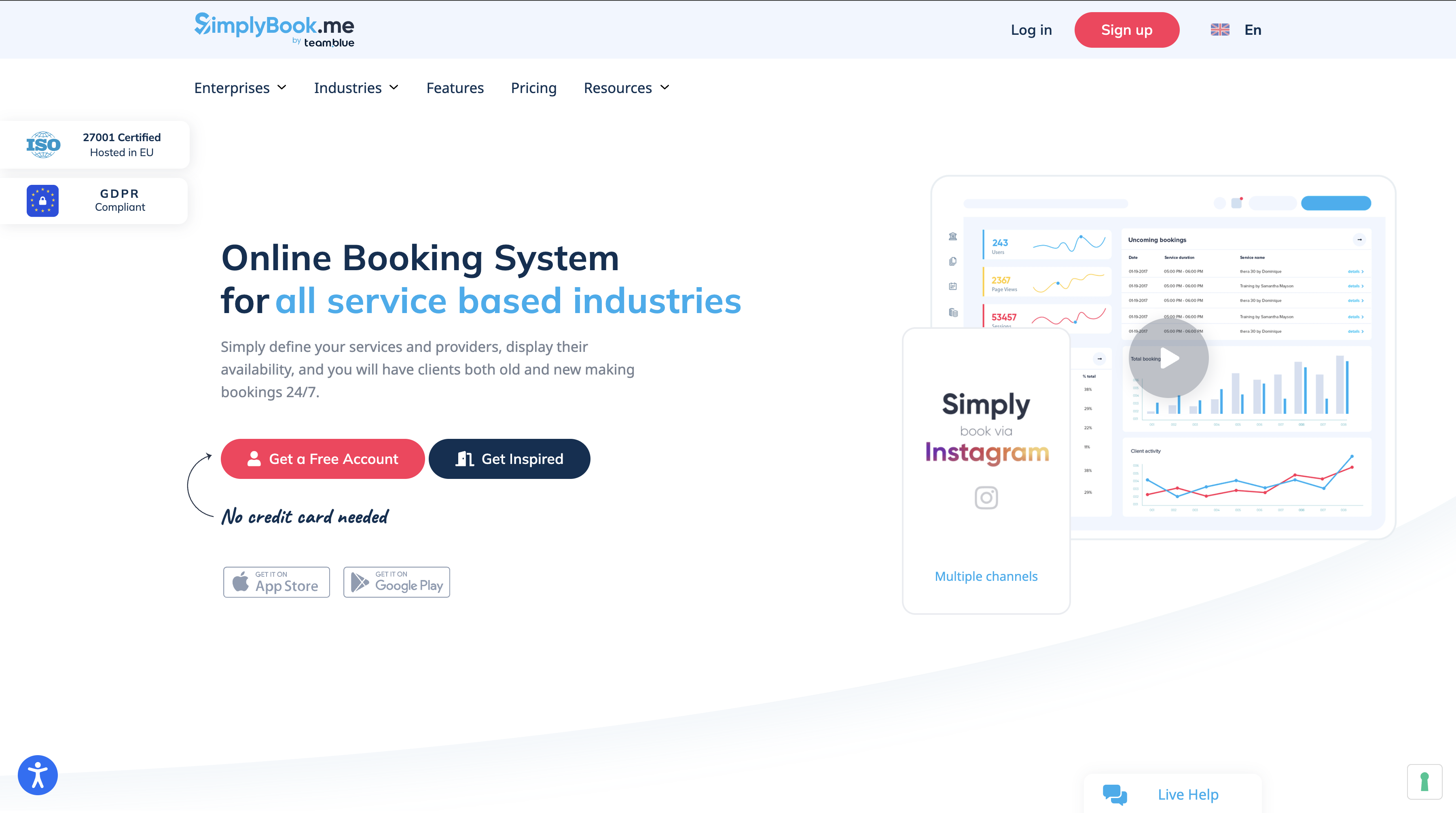
Integrations are SimplyBook.me's clear win. Through Zapier, Google Calendar, Google Meet, Stripe, Square, and dozens of third-party tools, you can wire it up to almost anything.
Opencals ships native integrations with Shopify, payment processors, and calendar systems, plus a developer API for the rest. It's built as infrastructure, so the intended path is embedding booking logic into your own app or site rather than living entirely on a hosted page.
Payment processing and order management
SimplyBook.me handles payments, deposits, cancellation fees, and gift cards through integrated payment processors.
Opencals ties payments to the booking and order lifecycle. Every booking creates an order linked to the customer record, revenue tracking, refunds, and operational status — so booking history, payment history, and status stay in sync. That matters most when those three drift apart on other setups.
| Integration Type | Opencals | SimplyBook.me |
|---|---|---|
| Zapier / third-party connectors | Limited | Extensive |
| Developer API | Full API access | Limited API |
| Shopify integration | Native | Via apps |
| Custom embedding | Embeddable widget only | |
| Workflow automation | Rules engine + API | Zapier workflows |
On fees specifically, SimplyBook.me's own guide says it doesn't tack on additional fees for payment integrations, and its pricing page says there are no transaction fees. I couldn't find a published rate for SimplyBook.me's own payment service compared with connecting your own processor, so ask before you assume. Opencals adds no fee on Stripe payments. Each merchant connects their own Stripe account, the charge is made on that account, and our payment code sets no application fee, so Stripe's own rate (2.9% + 30¢ on domestic online cards in the US) is the whole processing cost. If both are pass-through, the processing bill is the same and the choice rests on the rest of this page.
Industries and use cases
SimplyBook.me excels for:
- Hair salons, spas, and beauty services (strong marketing tools, client management)
- Medical and dental practices (compliance features, intake forms, HIPAA support via modules)
- Personal training and fitness (class management, memberships)
- Consulting and professional services (custom forms, calendar integrations)
- Small service businesses with standard appointment workflows
Opencals is purpose-built for:
- Rental businesses (multi-day reservations, resource management)
- Education and course providers (recurring classes, group capacity management)
- Tour operators and activities (multi-day bookings, group pricing)
- Service agencies managing projects across multiple locations
- Hospitality and accommodation (flexible check-in/check-out, resource allocation)
- Businesses with complex operational rules or non-standard service models
Warning
Platform architecture and extensibility
SimplyBook.me is a fully hosted, self-contained platform: you configure services, manage bookings, and handle customers inside its interface, and anything beyond that happens through external connectors and webhooks.
Opencals works as both a standalone platform and an infrastructure layer. You can run it as a complete booking system the way you'd run SimplyBook.me, or use its booking engine as a backend API behind your own app, website, or AI-driven interface. That's the main reason a team with developers would pick it: they can build their own booking UI on top of Opencals' logic.
For teams with developers or specific UX requirements, Opencals gives you far more room. For a business that just wants something plug-and-play, SimplyBook.me is the simpler answer.
Automation and operational workflows
SimplyBook.me sends automatic reminders, confirmations, and notifications by email and SMS, triggered by booking events for both clients and staff.
Opencals has configurable communication flows and notifications too, plus a rules engine for operational workflows and an AI assistant that can set up automations from a plain-language description. Teams using the API can build more elaborate custom workflows on top.
Scalability and growth trajectory
For solo operators and small teams
Both platforms start at roughly the same price. SimplyBook.me's free plan gives you 50 bookings a month; Opencals gives you a limited trial. A solo provider would do fine on either at this stage.
For growing SMBs (10–50 staff, multiple locations)
SimplyBook.me handles this tier smoothly. Pricing scales predictably, and the modular feature system lets businesses turn on functionality as they grow.
This is where Opencals' advantage shows up: multi-location coordination starts to matter once you're scheduling across teams and sites, and the usage-based pricing rewards volume. Past 500 bookings a month, the per-booking model often beats the equivalent SimplyBook.me tier.
For enterprise and multi-location operators
At enterprise scale Opencals is the stronger choice. White-label options, an API-first architecture, and the ability to embed booking logic into larger systems mean it scales with organizational complexity, not just booking volume.
SimplyBook.me still works for large organizations, but more as a component than as the operational backbone.
Define your booking volume
Estimate monthly bookings and compare fixed SimplyBook.me tiers against Opencals' usage-based pricing
Assess service complexity
If your services fit standard appointment slots, both work. If you need multi-day, multi-resource, or capacity-based booking, Opencals is better
Evaluate operational needs
Do you need multi-location coordination, complex automation, or custom integrations? That favors Opencals
Test trial experiences
Both offer free trials or limited plans. Configure a few bookings in each to feel how they handle your specific workflows
Migrating from SimplyBook.me to Opencals
The mechanical part of the switch takes most service businesses about a day. The harder part is the decision — which is why it gets put off. What actually moves and how:
Export customers and booking history from SimplyBook
Pull customer list and past bookings as CSV from SimplyBook's admin. Both export on every tier. Form responses and notes are tier-dependent — check before you cancel.
Import customers into Opencals
Bulk-import the customer CSV through Opencals' admin. Past appointments are kept as customer history attached to each record so the new staff member sees full context.
Recreate services and staff schedules
This is the biggest single chunk of time — typically 2–4 hours for a small business with 5–15 services and 1–5 staff. Working hours, locations, and service-staff assignments don't carry over automatically from any booking platform; it's a clean rebuild.
Set up payment processing
Connect Stripe (or use Shopify Payments if the business runs through Shopify). Deposits, refunds, and payouts move to the new processor — customers don't see a difference.
Redirect or replace the booking page
Point the existing booking URL at Opencals' hosted storefront, or embed the Opencals widget on your existing site. The customer-facing change is the new design — the URL can stay the same.
Run the old system in parallel for one week
Most teams keep SimplyBook running for a 7-day overlap so bookings made on the old system get honored, while new bookings flow into Opencals. After the overlap, cancel SimplyBook.
Note
The two things that surprise most teams during migration: how long the service-and-staff rebuild takes (longer than expected — block half a day, not "an hour"), and how little the customers notice (almost zero support tickets once the new booking page goes live).
Strengths and limitations
Pros
- Usage-based pricing rewards scaling
- Dynamic availability computation handles complex rules
- Multi-location operational coordination
- Infrastructure API for custom integrations
- AI-powered configuration assistant
- Strong rental and multi-day booking support
Cons
- Fewer third-party integrations out of the box
- Requires more technical setup for advanced customization
- Smaller user community compared to SimplyBook.me
- Learning curve steeper for non-technical users
SimplyBook.me strengths and limitations:
Pros
- Extensive Zapier and third-party integrations
- Strong intake form and questionnaire system
- Simpler, more intuitive interface for beginners
- Mature platform with larger user community
- Built-in marketing and promotional tools
- Strong support for beauty, fitness, and medical services
Cons
- Fixed tiered pricing can become expensive at scale
- Complex operational rules require workarounds
- Multi-day and rental bookings are awkward to configure
- Limited ability to customize booking logic or workflows without leaving the platform
- Less suitable for non-appointment service models
Typical use case winner
Choose Opencals if:
- You process 500+ bookings monthly and pricing per booking matters
- You operate across multiple locations with coordinated operations
- Your services include rentals, multi-day bookings, or non-standard time models
- You need to embed booking logic into custom applications or websites
- You want operational automation through APIs or rules engines
- You expect to grow into enterprise-scale operations
Choose SimplyBook.me if:
- You're a solo service provider or small team with standard appointment workflows
- You need extensive third-party integrations (Zapier, CRM tools, etc.)
- Your clients benefit from complex intake forms and pre-booking questionnaires
- You want an established platform with a large support community
- You're in beauty, fitness, or medical services with standard scheduling patterns
- You prefer simplicity over operational customization
Other SimplyBook alternatives worth considering
Opencals isn't the right fit for every business that's outgrown SimplyBook. A few honest pointers:

Acuity Scheduling
Strongest pick if your business is appointment-only and you want a polished, well-established platform with strong intake forms.
Calendly
Right answer for solo consultants and coaches doing 1:1 calls — overkill cost-wise for anything with deposits, staff, or rentals.

Fresha
Beauty and wellness specialist with built-in marketing and a customer-discovery marketplace. Strong vertical fit but locked to salon-style workflows.

Setmore
Generous free tier and similar feel to SimplyBook — worth comparing if cost is the primary trigger for leaving.
If your business is breaking out of standard appointment-based scheduling — rentals, multi-day bookings, classes with variable capacity, multi-location coordination — Opencals' operational model handles those natively. If you're staying in the appointment world but want a different platform feel, one of the four above is probably the better fit.
Flexible scheduling features
Learn how Opencals handles variable durations, capacity limits, and complex availability rules
Multi-location management
Discover how to manage schedules, staff, and services across multiple locations from one dashboard
Frequently asked questions
Frequently Asked Questions
Get started
Ready to transform your service business?
Join 150+ businesses already using Opencals. Start on a free development store with every feature unlocked, and only pay once you go live.