

Open-source car rental software: BookCars, then a long drop

If you run a small rental company and want renters to book and pay on your own site, our pick is Opencals with the NOIR car rental template: each car is booked by date range and held while the renter checks out, licence and ID uploads and per-day extras sit in the checkout, and nobody takes a share of the trip. If the software itself must be open source and you'll host it, BookCars (MIT, version 9.5.0, Node and MongoDB, with a mobile app) is the one platform worth installing. After it, the list falls away fast: a 2018 PHP 5.6 script, a project called "Rental" that rents holiday homes, and paid Odoo modules. This page is part of our comparison of open-source booking systems by what you book.
- Our pick for a rental company that wants its own booking site: Opencals with NOIR. Renters book and pay on your domain with no marketplace share; each car is its own product booked by date range and held during checkout; licence and ID uploads, a deposit-and-terms checkbox and per-day extras are part of the checkout. The NOIR front end is MIT, so you own and rebrand it. Cost: $0.99 per booking with no monthly fee, or $14.98 a month with 300 bookings included (opencals.com/pricing, checked 20 November 2026). Opencals itself is hosted, not open source.
- BookCars is the open-source pick: the only maintained, MIT-licensed car rental platform I found, with fleet, suppliers, Stripe and PayPal, deposits, pay at the counter, a web app and an Expo mobile app. You run Node, MongoDB as a replica set, and Redis. Read its "Block Car On Successful Payment" setting before you go live.
- Rent&Ride is a peer-to-peer car marketplace script from 2018 (PHP 5.6, AngularJS, OSL 3.0). Skip it for anything new.
- Openfront Rental is MIT and active, but it's for holiday homes. Odoo's car rental add-ons are proprietary and paid.
- Turo takes 10% to 30% of the trip price; HQ Rental Software starts at $120 a month. Those are what your own system is really being compared with.
Which car rental software should a rental company pick?
It depends on who runs the servers and where your renters come from. I build Opencals, so weigh my pick with that in mind: for an agency that wants its own branded booking site without hosting anything, Opencals with NOIR; for a team with a developer that wants every line of code, BookCars; for an agency that needs demand more than margin, Turo next to your own site. The table matches each situation to a pick and the reason.
| Your rental company | Our pick | Why |
|---|---|---|
| Wants renters to book and pay on its own site, no servers | Opencals + NOIR template | Date-range bookings held during checkout, licence uploads and extras in checkout, MIT front end, $0.99 per booking |
| Has a developer and wants to own and host every line | BookCars 9.5.0 | MIT, customer site + admin + mobile app, Stripe or PayPal, multi-supplier |
| Needs renters more than margin | Turo, next to your own site | Turo brings demand and protection; keeps 10–30% of each trip |
| Needs contracts, inspections and mileage billing at the counter | HQ Rental Software | A full counter system, from $120 a month |
| Is building a peer-to-peer car sharing marketplace | Start from something maintained | Rent&Ride's data model is a reference, its 2018 stack isn't |
Turo sends you renters, HQ runs your counter, and neither is yours
Before anyone searches for open-source car rental software, they're usually comparing it with one of two things.
Turo is a marketplace. You list cars, Turo brings renters, handles payment and adds its protection plan. In the US, hosts pick an earnings plan that keeps 70%, 80% or 90% of the trip price (Turo help centre, checked 15 November 2026). The lower your share, the more protection you get. The renter is Turo's customer first and yours second.
HQ Rental Software is the counter system many independent agencies run: reservations, contracts, fleet and a booking widget. Its own blog lists Basic at $120 a month, Standard at $175, Professional at $250 and Enterprise on request (HQ Rental Software, 5 May 2026, checked 15 November 2026).
An open-source system is the third road: no share of each trip and no monthly licence, in exchange for hosting, patching and fixing it yourself. That trade only works if the project is alive. For cars, that narrows the field to one.
BookCars is a whole rental company in one repo
BookCars is an MIT-licensed platform by Akram El Assas, the one copyright holder named in its LICENSE. On 15 November 2026 the backend, frontend, admin and mobile package.json files all said 9.5.0, and the repo showed 641 stars, 280 forks and 3,529 commits. The README's Android APK link still points at the 9.2 release, so the app download trails the code.
What you get, from the README and wiki:
- Four apps. An Express 5 API on MongoDB (Mongoose 9), a React 19 customer site, a React and Vite admin panel, and an Expo mobile app for Android and iOS.
- One company or many suppliers. Each supplier manages its own fleet through the admin panel, with a vehicle scheduler and supplier contracts. That makes it usable as a small aggregator, not just one agency.
- Real rental pricing. Hourly, daily, bi-weekly, weekly and monthly rates per car, discounted prices, date-based rates and a supplier price change rate, combined by its price calculation.
- Rental rules. Minimum notice before pick-up, minimum rental length, allowed pick-up and drop-off hours.
- Payments. Stripe or PayPal; customers pay in full, pay a deposit, or pay at the counter. Eight languages and 134 currencies.
- Locations as a hierarchy of countries, child locations and parking spots, shown on a map.
There's a public demo at bookcars.wexdev.com with logins in the README. For a feature list, nothing else in this category comes close.
BookCars blocks a car when the payment succeeds, so test that first
This is the part of BookCars I'd check before anything else, because it decides whether you double-book a car.
The wiki's FAQ says a car stops appearing in search for overlapping dates when "Block Car On Successful Payment" is enabled on the car, and that it's enabled by default. Turn it off and "the car can still appear in search results even if it's already booked during that time"; you then hide it by hand, by marking it unavailable or fully booked in the admin panel.
Two things follow from that wording:
- The block is tied to a successful payment. BookCars also offers pay at the counter and a deposit option ("Authorize Payment Later" on the supplier). Before you go live, book the same car twice with pay at the counter and see what the second customer gets. I didn't install it, so I'm telling you what to test, not what happens.
- Your database has to run as a replica set. The backend's
.env.examplesaysreplicaSet=rs0"is required for MongoDB transactions/concurrency locks (e.g. saveBookingsWithAvailability)". The Docker setup starts MongoDB 7.0.12 as a one-node replica set and adds Redis 7. If you move to a managed database later, keep that, or the lock that stops two bookings landing at once goes with it.
Neither is a reason to avoid BookCars. They're the reason to spend an afternoon with the demo before you point real customers at it.
Rent&Ride was a €60,000 script in 2018, and it shows
Rent&Ride comes up in almost every list of open-source car rental software. Its README says Agriya sold it for "around 60000 Euros" before releasing it under a dual licence, OSL 3.0 and commercial.
What I found on 15 November 2026:
- 8 commits, 56 stars, copyright "2014-2018".
- PHP 5.6 or later, MySQL 5.x, Lumen and AngularJS, built with Bower and Grunt. PHP 5.6 stopped getting security fixes at the end of 2018, and Google ended AngularJS support at the end of 2021.
- It's a Turo-style marketplace, not an agency system. Owners list cars, the site owner takes a service charge per rental, and disputes between renters and owners have their own module. Payments go through ZazPay.
- The README's "How it works" paragraph is still lorem ipsum ("it has survived not only five countries, but also the leap into electronic typesetting").
- OSL 3.0 treats running a modified copy as a public site like distributing it, so your changes have to be published. Pull requests also grant Agriya a perpetual licence to what you submit.
If you want to build a peer-to-peer car sharing site, it's a historical reference for the data model. I wouldn't put customer card details behind it.
Openfront Rental rents holiday homes, not cars
The name is the trap. openship's Openfront Rental is MIT, recent and part of a family of about 30 self-hostable Openfront apps, and its README describes "a self-hostable platform for professional short-term accommodation managers": properties, units, stays, owner statements. No cars.
The family's car-related app is Openfront Dealership, which covers "inventory, test drives, deals and service". That's a dealer's showroom, not a rental counter. Two more notes from the Rental README worth knowing if you came for accommodation instead: its Stripe card adapter "is explicitly test-mode only and rejects live-mode payments", and there's no native channel-manager adapter, only iCalendar exchange.
If holiday homes or villas are what you rent, the open-source hotel booking systems comparison is the better page.
Odoo tracks your fleet; the rental part is a paid module
Odoo's Fleet app tracks vehicles a company owns: contracts, services, fuel. Turning it into customer rentals means an add-on from the Odoo Apps store, and the car rental ones I opened are proprietary. One example, Car Rental Management for Odoo 16.0, costs $100.49 under the OPL-1 (Odoo Proprietary License) and depends on Fleet, Sales, Discuss and Invoicing (Odoo Apps, checked 15 November 2026).
That route makes sense if Odoo already runs your accounting. It isn't open-source car rental software, whatever the search result calls it.
Search GitHub for "car rental system" and most of the rest are single-author demos. I couldn't find another maintained, licensed platform beyond the four above.
Licence, stack and who holds the car, checked 15 November 2026
| Option | Licence | Stack | Takes payments | What blocks a booked car |
|---|---|---|---|---|
| BookCars 9.5.0 | MIT | Node (Express 5), MongoDB replica set, Redis, React 19, Expo | Stripe or PayPal; full, deposit or at the counter | "Block Car On Successful Payment" (on by default) |
| Rent&Ride | OSL 3.0 or commercial | PHP 5.6+, MySQL 5.x, Lumen, AngularJS | ZazPay | Marketplace model; last code 2018 |
| Openfront Rental | MIT | Next.js, Keystone 6, Prisma | Stripe adapter is test mode only | Built for stays, not cars |
| Odoo car rental module | OPL-1, $100.49 (Odoo 16.0) | Odoo + Fleet, Sales, Invoicing | Through Odoo | Depends on the module |
| Turo | Proprietary marketplace | Hosted | Turo collects; you keep 70–90% | Turo's calendar |
| HQ Rental Software | Proprietary, from $120/mo | Hosted | Yes | HQ's reservations |
| Opencals + NOIR template | Engine hosted; template MIT | Next.js 15 on a hosted API | Stripe, cash or no payment | The car is held while it's in checkout |
Sixty three-day rentals a month, priced six ways
Take a small agency doing 60 rentals a month, three days each, at $80 a day: $14,400 of rental revenue. Card processing is extra on every route except Turo, where the renter pays Turo.
| Route | Monthly cost | What it covers |
|---|---|---|
| Turo, 80% plan | $2,880 (20% of trip price) | Renters, payment, Turo's protection plan |
| Turo, 90% plan | $1,440 | The same with less protection |
| HQ Rental Software, Basic | $120 | Counter software; you find the renters |
| BookCars, self-hosted | $0 licence | Your server, MongoDB, Redis, backups and your time |
| Opencals Elastic | $59.40 (60 × $0.99) | Every feature, no monthly fee |
| Opencals, build your plan | $39.95 | $14.98 base (300 bookings included) + Flexible duration $9.98 + Customer self-service $14.99 |
Opencals prices are from opencals.com/pricing, checked 15 November 2026. A three-day rental is one booking on our engine, because the slot spans the days. The fixed plan covers up to 3 locations and 10 staff self-serve; a garage plus a delivery zone is two. Below about 40 rentals a month, Elastic is cheaper.
Turo's line isn't the same thing as the others: it includes insurance-style protection and demand you'd otherwise pay for in ads. Keeping a few cars on Turo while the rest book through your own site is a reasonable mix.
NOIR: your own rental site on a hosted engine
Opencals isn't open source. It's a hosted booking and commerce engine, and the thing that is open source is the front end: NOIR Drive, an MIT Next.js 15 template for a car rental company, set in Dubai with twelve cars and four chauffeurs.
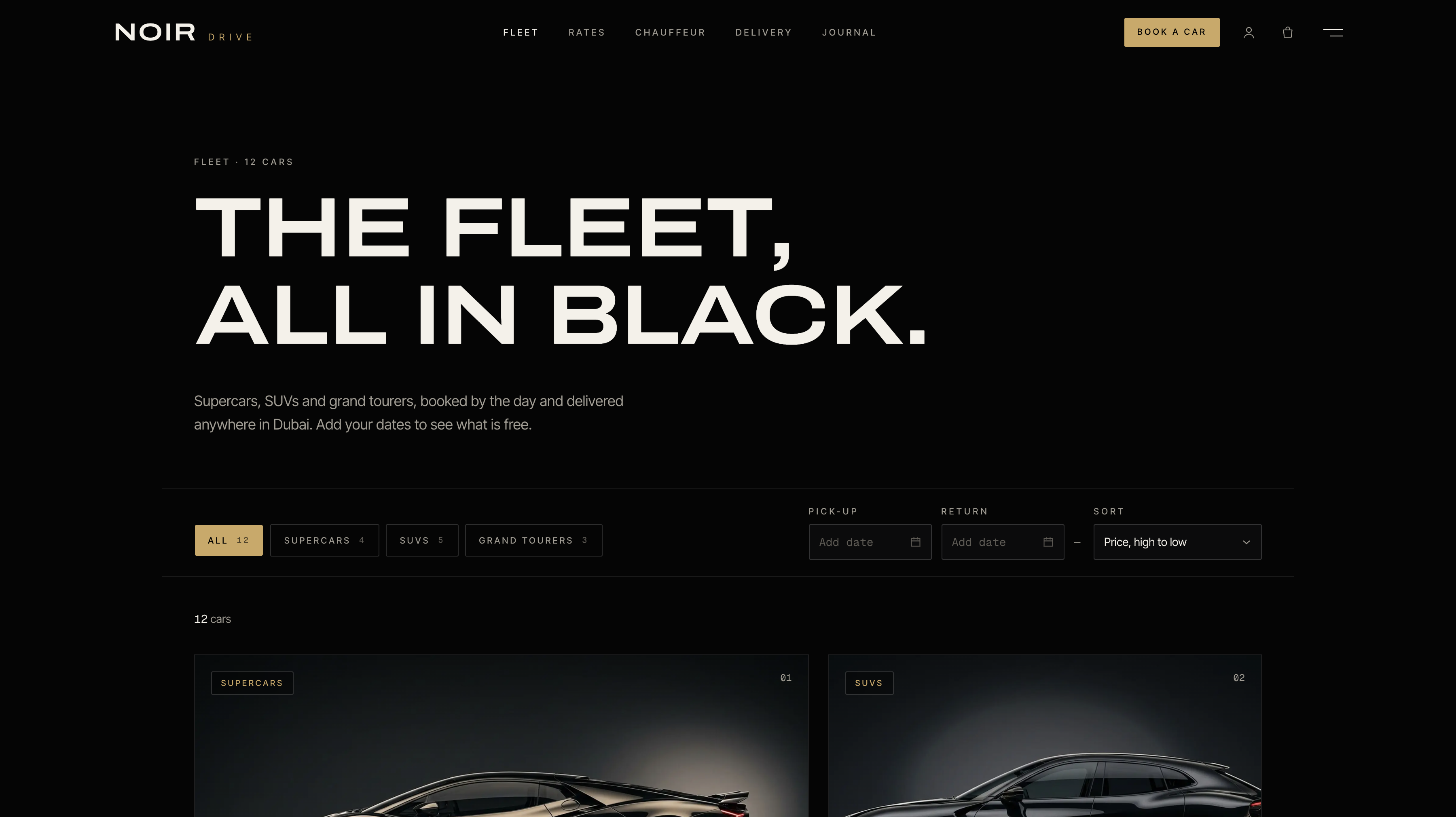
The rental model, from its README:
- Each car is its own product with no staff, a one-day base duration, custom lengths up to 30 days in the seed, and one renter at a time. Each car sits in its own product pool, so a booking blocks it at the garage and at the delivery location.
- Availability is a range, not a slot. Cars run on a 24/7 schedule, the site reads merged availability ranges, and the server re-checks the dates when the booking is made.
- The car is held while it's in checkout. Adding it to the cart creates a hold on those dates before any payment, and holds that aren't paid expire.
- Rental paperwork goes in the checkout questions: driving licence and passport or ID uploads, date of birth, and a deposit-and-terms checkbox. Per-day extras (excess waiver, additional driver) and fixed extras (child seat, prepaid fuel) are priced by the engine.
- Customers get accounts where they can move a rental to new dates of the same length, or cancel within your policy.
What NOIR on Opencals doesn't do
The security deposit is shown and accepted at checkout but held on a card at handover, not pre-authorised online. There's no licence verification, no check-in inspection, no mileage or damage charges, and one price per day in the template (no weekend or seasonal rates). The free Dev Store runs in test mode and can't take real payments until you move to a live store.
The trade against BookCars is plain. BookCars gives you the code for everything, including the admin panel and a mobile app, and you run four apps and a replica-set database. Opencals gives you the storefront code and rents you the booking engine, dashboard and payments, so there are no servers to patch.
When to choose Opencals for car rental, and when to choose something else
Choose Opencals with NOIR when:
- You want bookings on your own domain, not a marketplace listing, and no share of each trip.
- You rent by the day or longer. Each car is a product booked by date range, a three-day rental is one booking, and custom lengths up to 30 days are in the template's seed (the Flexible duration add-on, $9.98 a month, on the fixed plan).
- Two renters must never get the same car. The car is held on those dates as soon as it's in a cart, and unpaid holds expire.
- Your checkout needs rental paperwork and upsells: licence and ID uploads, date of birth, a deposit-and-terms checkbox, per-day extras like an excess waiver or an additional driver, fixed extras like a child seat.
- Renters should manage their own bookings from an account, moving a rental to new dates or cancelling within your policy (Customer self-service add-on, $14.99 a month, on the fixed plan).
- You deliver as well as hand over at a garage, with up to 3 locations and 10 staff self-serve on the fixed plan, more on a custom plan.
- You want to test before paying anything: the Dev Store is free, with every feature in test mode.
Choose something else when:
- The whole system must be open source and on your servers: BookCars. Test the payment-block setting and pay-at-counter bookings on its demo first, and keep MongoDB as a replica set.
- You need a full rental back office today: contracts, check-in inspections, licence verification, mileage and damage charges. That's HQ Rental Software's job; Opencals with NOIR covers the booking, payment and paperwork collection, not the counter.
- You need the security deposit pre-authorised online: in NOIR it's accepted at checkout and held on a card at handover, and deposits on Opencals are still in beta.
- You need renters more than your own brand right now: stay on Turo for some of the fleet while your own site grows.
- You're building a peer-to-peer car sharing marketplace: read Rent&Ride's data model, then start from something maintained.
- You rent holiday homes, not cars: Openfront Rental or the hotel and villa options.
What this check can't tell you is how BookCars behaves at 200 cars and ten suppliers. I read its code, docs and settings; I didn't run a fleet on it. If you have, I'd like to hear what broke.

NOIR Drive: car rental template
The MIT Next.js template behind the Opencals option: date ranges, delivery or garage, chauffeurs, accounts.

Open-source hotel booking systems
QloApps, HotelDruid, Odoo's PMS and WordPress plugins, for stays rather than cars.

Lumbung Sidemen: villa rental template
The template for renting villas and holiday homes by the night.

Open-source booking systems
The wider list of self-hosted booking software, by resource type.

Headless booking system
Why a hosted engine with your own front end can beat self-hosting.
Frequently Asked Questions
Get started
Ready to transform your service business?
Join 150+ businesses already using Opencals. Start on a free development store with every feature unlocked, and only pay once you go live.