

Otherdoor: a free escape room template that sells the whole room to the whole team

An escape room sells something odd: a whole room, for an hour, to one group, at a price that depends on how many of them turn up. Most website templates for escape rooms don't get that far. In November 2026 the free Hidden Door template on Framer sends visitors to your own booking links. Keyhole ($29 on Framer) shows "tonight's open slots" with "native Framer booking and contact forms", and says nothing about checking availability or taking payment. The one WordPress plugin called Escape Rooms was last updated 12 years ago, has 10+ active installs, and its only review says it doesn't take payment or check for overlapping bookings.
Otherdoor is the template we built to do the booking part properly. It's a free, MIT-licensed Next.js site for an escape room company, with booking, team-size pricing and checkout running on Opencals, the booking and checkout engine we build. If you run (or build sites for) a venue with several themed rooms and want bookings and payments on your own site, it's our pick for that job. If you already run dedicated escape room software and only want a new look, keep your software and copy the design ideas below.
Otherdoor is a free escape room website template (Next.js 15, MIT licence) on the Opencals API. Each room is booked privately by the whole team, priced by team size (in the demo, the Jaguar Temple is £70 for two or £138 for six), with extras like a team portrait or a bottle on ice, a 15% matinee discount and per-head workshops. Every room gets its own landing page with its own look. The demo runs six rooms at two Edinburgh venues. The template is free; bookings run on a free Opencals development store for testing, then cost $0.99 each or $14.98 a month for 300 (checked November 2026).
Priced by the team, booked by the room
Generic booking tools sell escape rooms as tickets: £30 a head, six seats. That breaks the two rules every escape room runs on. Strangers can buy the remaining seats of your private game, and a team of two pays the same per head as a team of six, which isn't how anyone prices a room that costs the same to run either way.
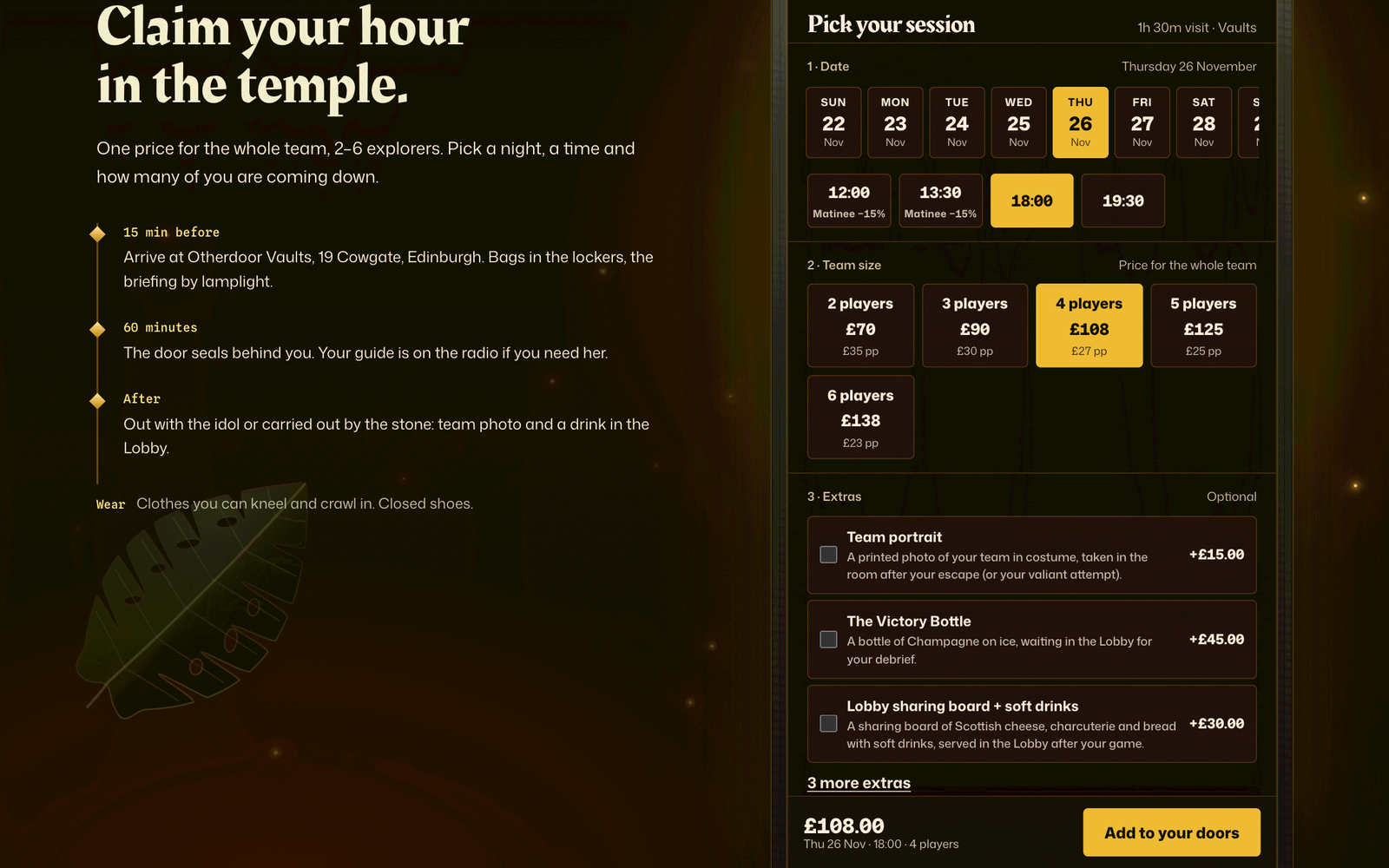
Otherdoor books the whole room. Each team size is its own priced option, and the button shows both the group price and the price per head. These are the demo's two ends of the range:
| Team | The Jaguar Temple (60-min game) | Kepler Station (90-min game) |
|---|---|---|
| 2 players | £70 (£35 each) | not offered |
| 4 players | £108 (£27 each) | £160 (£40 each) |
| 6 players | £138 (£23 each) | £216 (£36 each) |
| 8 players | not offered | £256 (£32 each) |
Under the hood, each room is one product with a variant per team size (jaguar-temple-4p is "4 players" at the group price), every variant has room for exactly one booking, and all of a room's variants share a product pool. That pool is what makes it work: once a team of four books the Jaguar Temple at 18:00, the 2-player and 6-player options for 18:00 disappear too, because they're the same room. Kepler Station is the exception that proves the model: a 120-minute visit for 4 to 8 players, so its sessions sit on a two-hour grid instead of 90 minutes.
The booking panel itself is plain on purpose: a date strip right above the session times, team sizes, extras as checkboxes, and the total with "Add to your doors" always in view. Matinee sessions (Monday to Thursday before 15:00) are tagged −15% in the time list, and the discount comes from the store, not from front-end arithmetic.
Extras are where the margin is
The same panel sells the add-ons a venue's front desk usually forgets to offer. In the demo, every room has them:
| Extra | Demo price |
|---|---|
| Team portrait (printed photo, taken in the room) | £15 |
| Birthday ceremony | £18 |
| Costume rail | £20 |
| Your escape on film | £25 |
| Lobby sharing board with soft drinks | £30 |
| The Victory Bottle (Champagne on ice for the debrief) | £45 |
A team of four in the Jaguar Temple with a portrait and the bottle is £168 instead of £108, paid up front. Checkout then asks the store's own questions (team name, occasion, experience, anything we should know), and the team name comes back on the confirmation.
The demo also sells two workshops at the Leith venue, priced per head with a seat stepper: Ciphers & Secret Inks (£24, 75 minutes, 10 seats, age 10+) and Lockpicking 101 (£28, 60 minutes, 8 seats, age 16+). They're the staff-led products in the store, so a teacher can't be double-booked across them.
Six rooms, six websites
This is the part people will screenshot. Otherdoor's home page is the Corridor: six lacquered doors with lit reeded glass. Hover one (or tap on a phone) and its lever turns, the door swings out on its hinge, and the room's video loop starts behind it while the whole site takes on the room's colour. Mood filters (the past, the future, family, hardest, scariest) reorder the corridor, a four-question "which door is yours?" picker opens one door, and a keypad lock hides a discount code. In the demo the code is 2187, which opens OTHERDOOR for 10% off, once per customer.
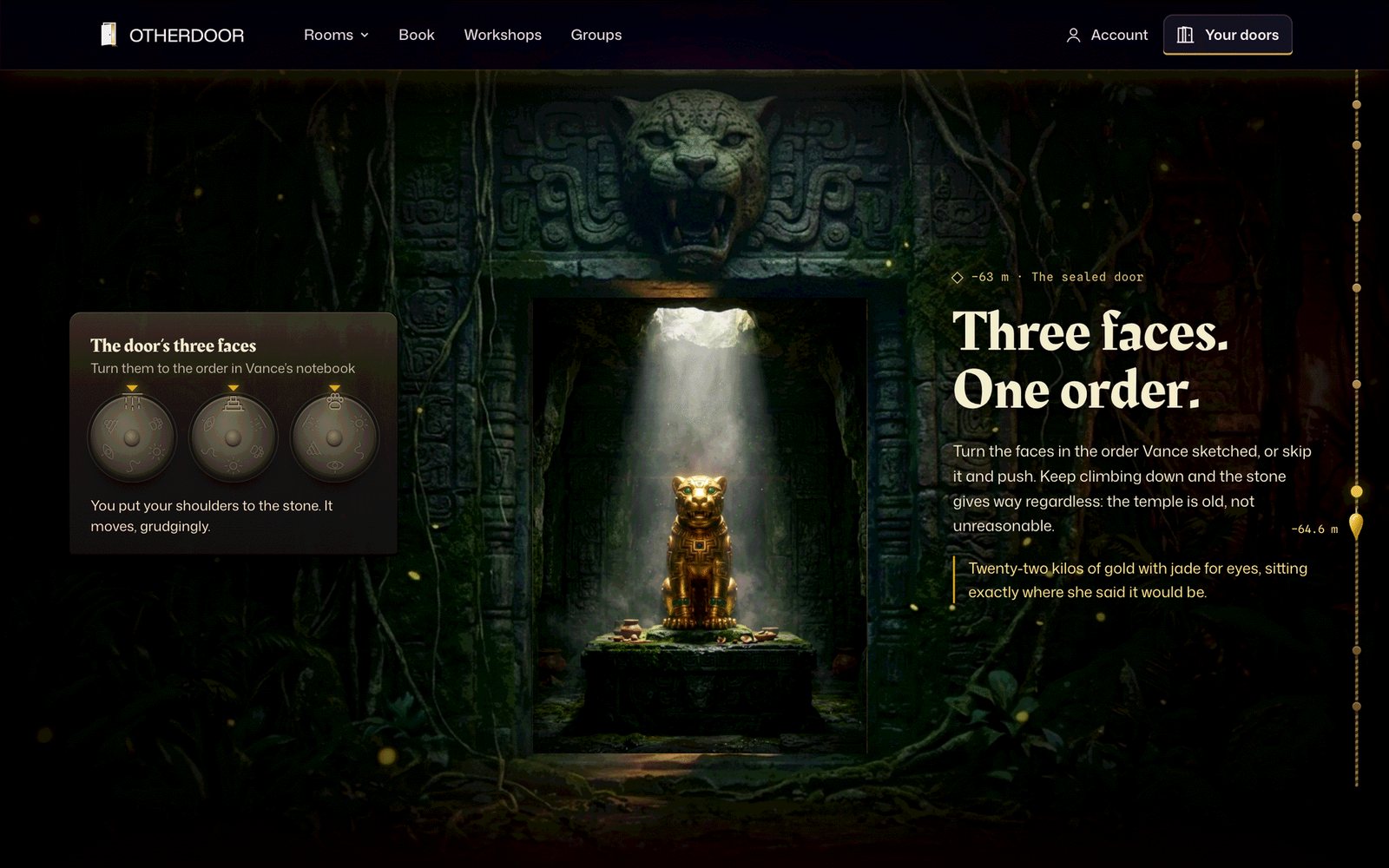
Then every room gets its own landing page at /rooms/<slug>, with its own palette, display font, layout and motion. They share only the header, the footer and the booking panel:
- The Jaguar Temple (1936): one long descent from the canopy to the idol chamber, with a glyph lock on the sealed door.
- The Gaslight Affair at No. 9 (1891): a gaslit street, then an evidence wall with red string that draws itself and a reading glass that finds clues.
- Protocol Zero (2071): the page is the rogue AI's interface and decays from clinical white to alarm red as you scroll.
- Kepler Station (2187): a station you can turn, a docking approach and a power board that relights the whole page.
- The Hôtel Lumière Job (1963): a comic book with a playable laser grid and a safe dial.
- The Clockmaker's Workshop (family, 7+): a wind-up mechanical toy with five brass keys hidden on the page.
For an escape room this matters more than for most businesses, because the theme is the product. A room page that feels like the room sells the hour better than a photo and a paragraph.
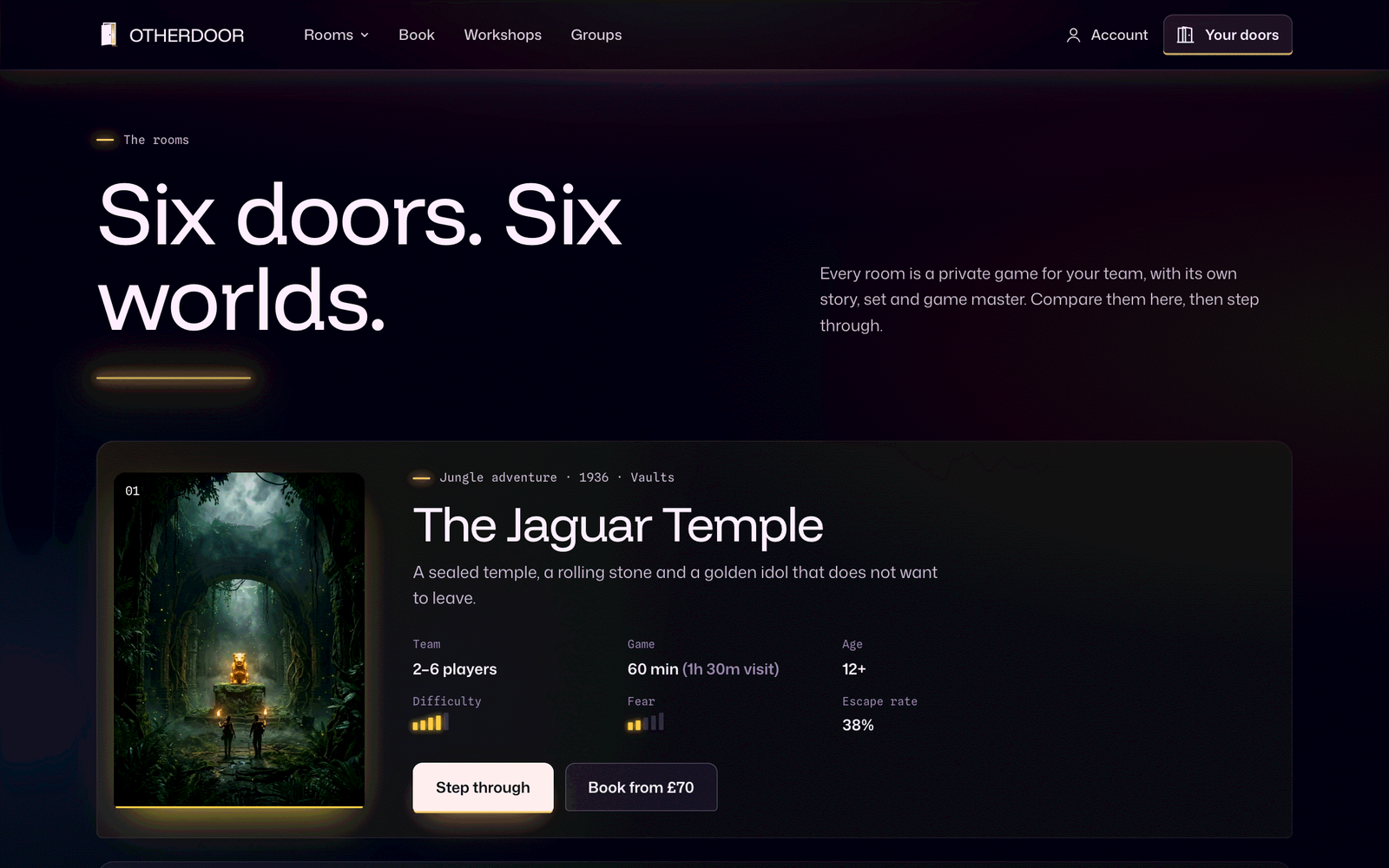
/rooms compares all six side by side with the numbers players actually ask about. From the demo:
| Room | Venue | Team | Game | Age | Escape rate |
|---|---|---|---|---|---|
| The Jaguar Temple | Vaults | 2–6 | 60 min | 12+ | 38% |
| The Gaslight Affair at No. 9 | Vaults | 2–5 | 60 min | 12+ | 52% |
| Protocol Zero | Vaults | 2–6 | 60 min | 14+ | 33% |
| Kepler Station | Leith | 4–8 | 90 min | 12+ | 24% |
| The Hôtel Lumière Job | Leith | 2–6 | 60 min | 12+ | 57% |
| The Clockmaker's Workshop | Leith | 2–6 | 60 min | 7+ | 72% |
Difficulty, fear, escape rate and the room record aren't API fields; they live in lib/site-config.ts with each room's palette and media, so you update them by hand.
One read per room keeps the corridor fast
A corridor with six rooms, live "Tonight" sessions and a booking board could easily hammer an API. Otherdoor reads each room's availability once for the whole booking window, caches it for 60 seconds, and cuts it into sessions on the room's grid in the browser. Changing the date or the team size never calls the API again. /book shows every room's sessions for a day with a venue filter, and deep links work: /rooms/kepler-station?date=2026-12-05&time=18:00&team=6#book opens Kepler Station's panel with that session and team size picked, which is the link you'd put in a birthday-party email.
After the booking, the door unlocks
The cart is Your doors: slim cards edged in each room's colour, with a countdown for how long the session is held. Checkout is one page (your team, contact, payment) with Stripe, pay at the venue or bank transfer, whichever the store allows.
The confirmation is the moment the template has been building to: the booking reference keys into a lock and the door opens onto the room. Under it are the arrive-by time (15 minutes early), the venue and how to get there, what to wear, the phones-away note, calendar links and a teaser for the next door.
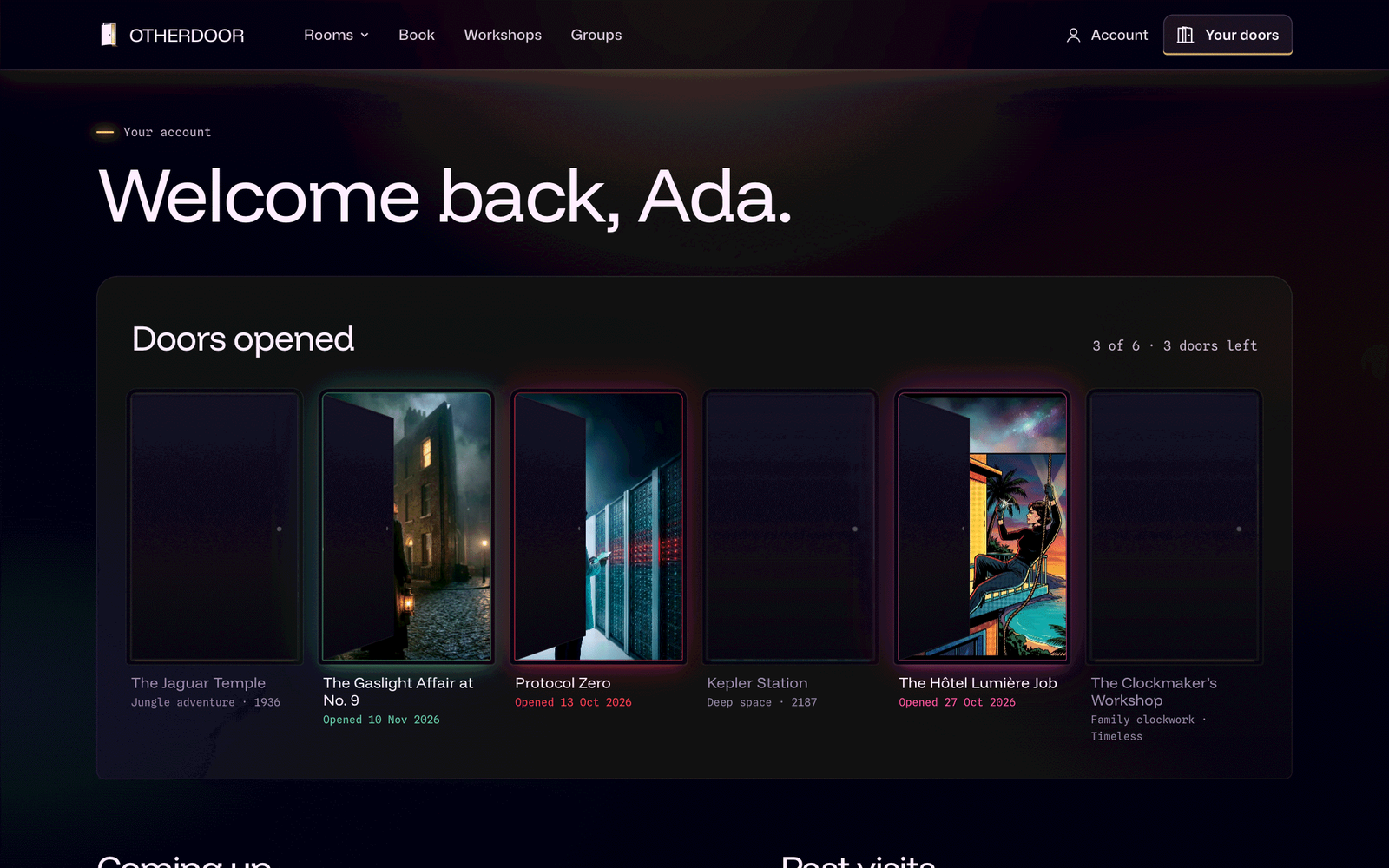
The account, Doors opened, shows every room as a door: the ones a player has done are open and lit with the date, the rest are closed. Upcoming bookings can be moved or cancelled up to 24 hours before. It's a collector's shelf, and it's the most honest repeat-visit nudge I've seen on a booking site: "3 of 6, 3 doors left". Sign-in is a 6-digit email code or a magic link from the booking email.
Six rooms at six sessions a day, priced
The template is free. Build and test it on a free development store: every feature works and there's no card, but it's in test mode and can't take real payments. Live stores pay per booking or a fixed monthly plan (opencals.com/pricing, checked November 2026). One room session is one booking whatever the team size, so six rooms running six sessions a day is roughly 1,000 bookings a month.
| Bookings a month | Elastic ($0.99 each, every feature) | Custom ($14.98, 300 included, then $0.20) | Custom + group appointments, self-service |
|---|---|---|---|
| 300 | $297.00 | $14.98 | $37.46 |
| 1,000 | $990.00 | $154.98 | $177.46 |
| 3,000 | $2,970.00 | $554.98 | $577.46 |
Past about 16 bookings a month the Custom plan is cheaper than paying per booking. Otherdoor needs two Custom add-ons: group appointments for the per-head workshops and self-service so players can move and cancel ($7.49 and $14.99 a month on the pricing page). The fixed plan covers up to 3 locations and 10 staff self-serve, which fits the demo's two venues and six game masters. Hosting (Vercel or any Node host) and Stripe's card fees are billed by them, not by us.
Where Otherdoor stops
Before you pick it, know what it leaves to you:
- Game masters aren't scheduled by the booking. Rooms are booked without staff (that's what lets the product pool block the room), so the engine doesn't check whether a game master is free at 19:30. Staff your rota to the room schedule.
- A new room needs its own world. The six rooms ship with hand-built landing pages. A room you add in the store gets a plain fallback page until someone builds its world;
components/worlds/README.mdexplains how, and it's real front-end work. - No waitlist, and no outgoing webhooks: booking events reach other tools through Zapier.
- The Hall of Fame is sample data. The demo labels its records as samples; there's no leaderboard that fills itself from real escape times.
- Currency follows the store. The demo charges in pounds because its store was created in the United Kingdom. Create yours in your own country.
If you sell private room sessions with a group price, extras and the odd workshop, none of these stop you. If you need game-master rostering built into booking, that's a gap today.
Open the first door yourself: seed, key, deploy
- Create a free development store at app.opencals.com in the United Kingdom to get the demo in pounds, and choose the Otherdoor dataset. It seeds the two venues, six rooms with their team-size variants and session grids, two workshops, six game masters, the extras, checkout questions and both discounts.
- In the dashboard, create a private storefront key (it starts with
spk_) under Account → API Keys. - Deploy with the button below and paste the key when Vercel asks.
| Variable | What goes in it |
|---|---|
OPENCALS_API_KEY | Your private storefront key (starts with spk_). The template forwards each visitor's IP with it, so rate limits count per visitor |
AUTH_SECRET | Any random string, used to encrypt player sessions |
OTHERDOOR_PREVIEW | Optional. 1 serves the /preview screens in production |
Card payments use the Stripe account connected to your store, so there's no Stripe variable to set. Set your domain as url in lib/site-config.ts for canonical URLs and Open Graph.
To rebrand, edit lib/site-config.ts (name, room stats, palettes, moods, venue copy, the door picker and the keypad code) and the tokens in app/globals.css; the design rules are in DESIGN.md. If you'd rather have an AI agent do the setup, the Opencals Agent Skills work in Claude Code, Cursor, Codex and Gemini CLI.
Otherdoor live demo
Open a door, pick a team size and watch the price per head.
Otherdoor on GitHub
MIT-licensed source. Fork it for your venue or a client.

METTLE: boutique gym template
Classes, PT and recovery on one clock, on the same engine.

VOLT: padel and squash template
Court grids and coaching, another room-by-the-hour model.

Gable: coworking template
Desks, rooms and booths on one day sheet.

Booking flow examples
Seven booking shapes and the API calls behind each.

Prevent double booking
Why one room needs one bookable unit, explained in depth.
Opencals pricing
$0.99 per booking or $14.98 a month for 300.
Frequently Asked Questions
Get started
Ready to transform your service business?
Join 150+ businesses already using Opencals. Start on a free development store with every feature unlocked, and only pay once you go live.