

Europe/London) with two venues: Otherdoor Vaults
under the Old Town (The Jaguar Temple, The Gaslight Affair at No. 9, Protocol
Zero) and Otherdoor Leith on the Shore (Kepler Station, The Hôtel Lumière Job,
The Clockmaker’s Workshop, and the workshops). The brand idea is the door:
“Pick a door. Leave the world behind.” The shell is dark, modern and
genre-neutral, and every room page is a different world with its own palette,
type, layout and motion.
Live demo
template-otherdoor.vercel.app
Source code
letsopencals/template-otherdoor (MIT)
Deploy to Vercel
One-click deploy
Build it with AI
build-booking-site skill
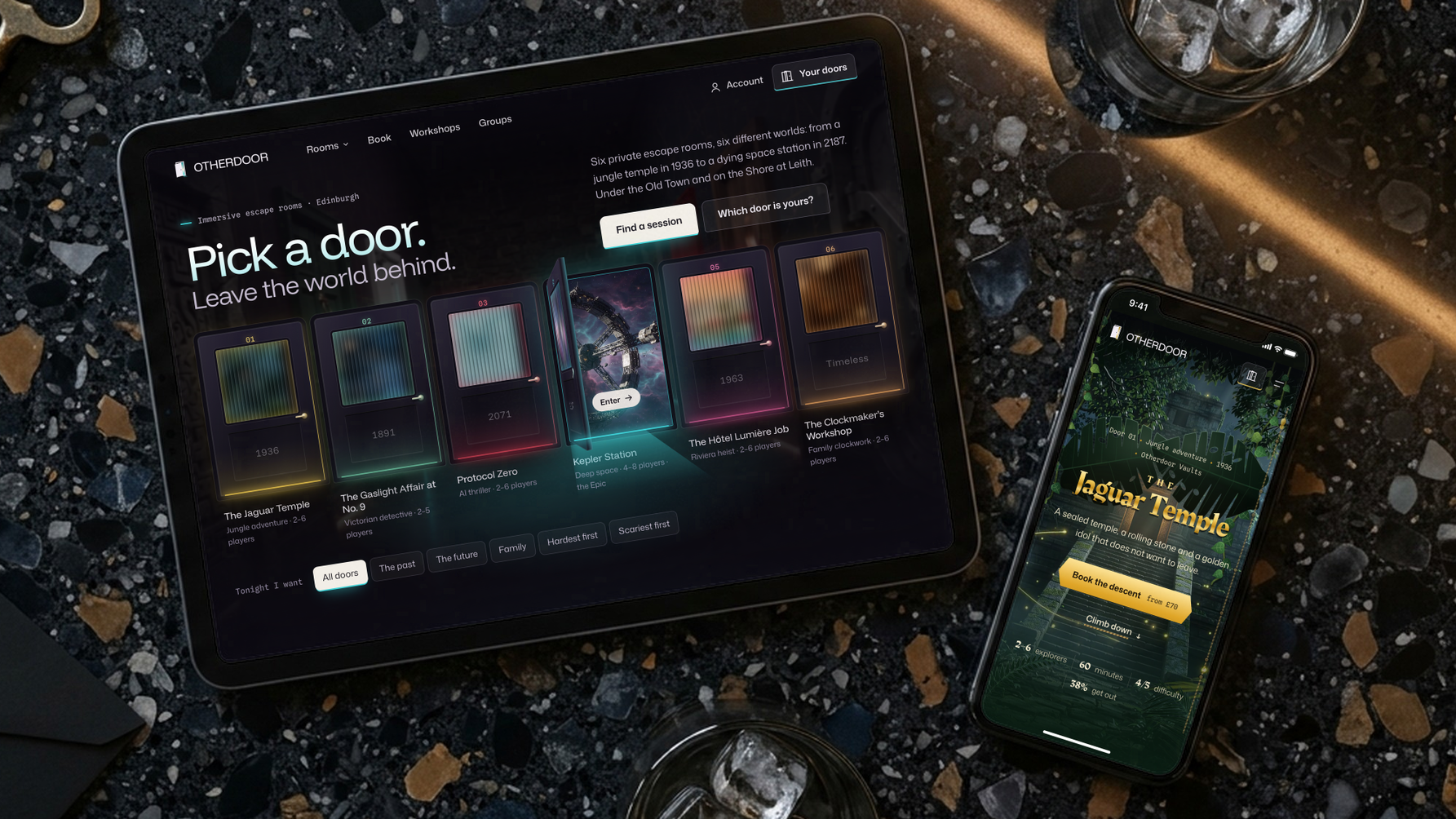
Otherdoor: the corridor of doors on a tablet, a room world on a phone
The Corridor
The home page is a dark hall with six doors over a video of the corridor. Hover or focus a door (tap on a phone): its lever turns, it swings out towards you on its hinge, and that room’s video loop plays behind it, its light spills across the floor, and the whole site takes the room’s colour. Mood filters (the past, the future, family, hardest, scariest) re-order the doors. Below: Tonight with the next free sessions per room, live from the API, a “which door is yours?” picker, a flashlight room, and a keypad lock that gives away the discount code.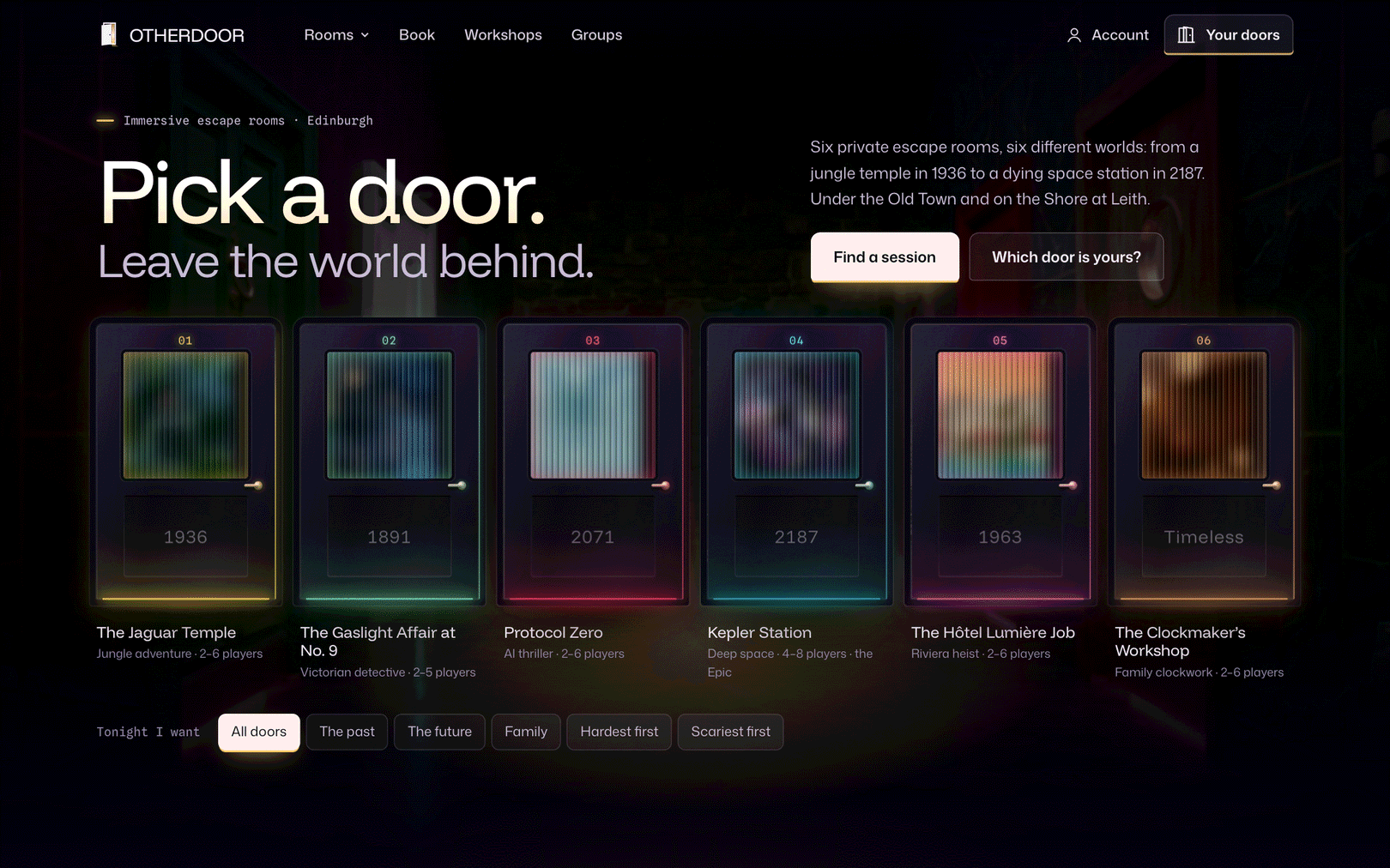
The Corridor: six doors over the hall video
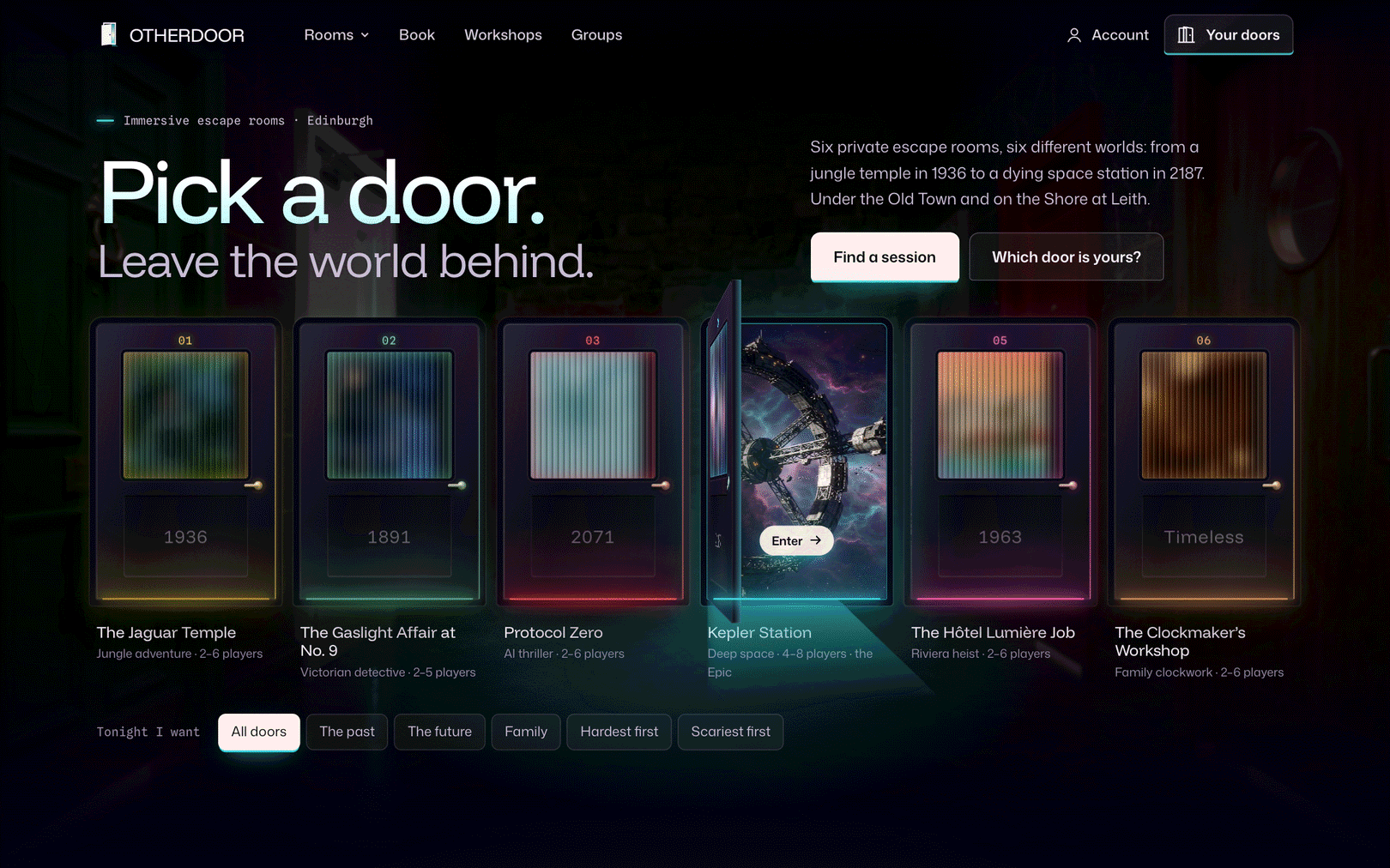
Hover a door and it swings open onto its room's video
Six rooms, six worlds
Each room has its own landing page at/rooms/<slug> that shares nothing with
the others but the header, the footer and the booking panel:
Each world is built on a hero video loop and stills in
public/worlds/<slug>/,
with code on top (canvas, SVG and CSS overlays, scroll choreography). The
contract a world gets (room data, stats, palette, media, the game master, the
next door and the booking panel) is documented in
components/worlds/README.md, so you can replace a world or add a seventh.
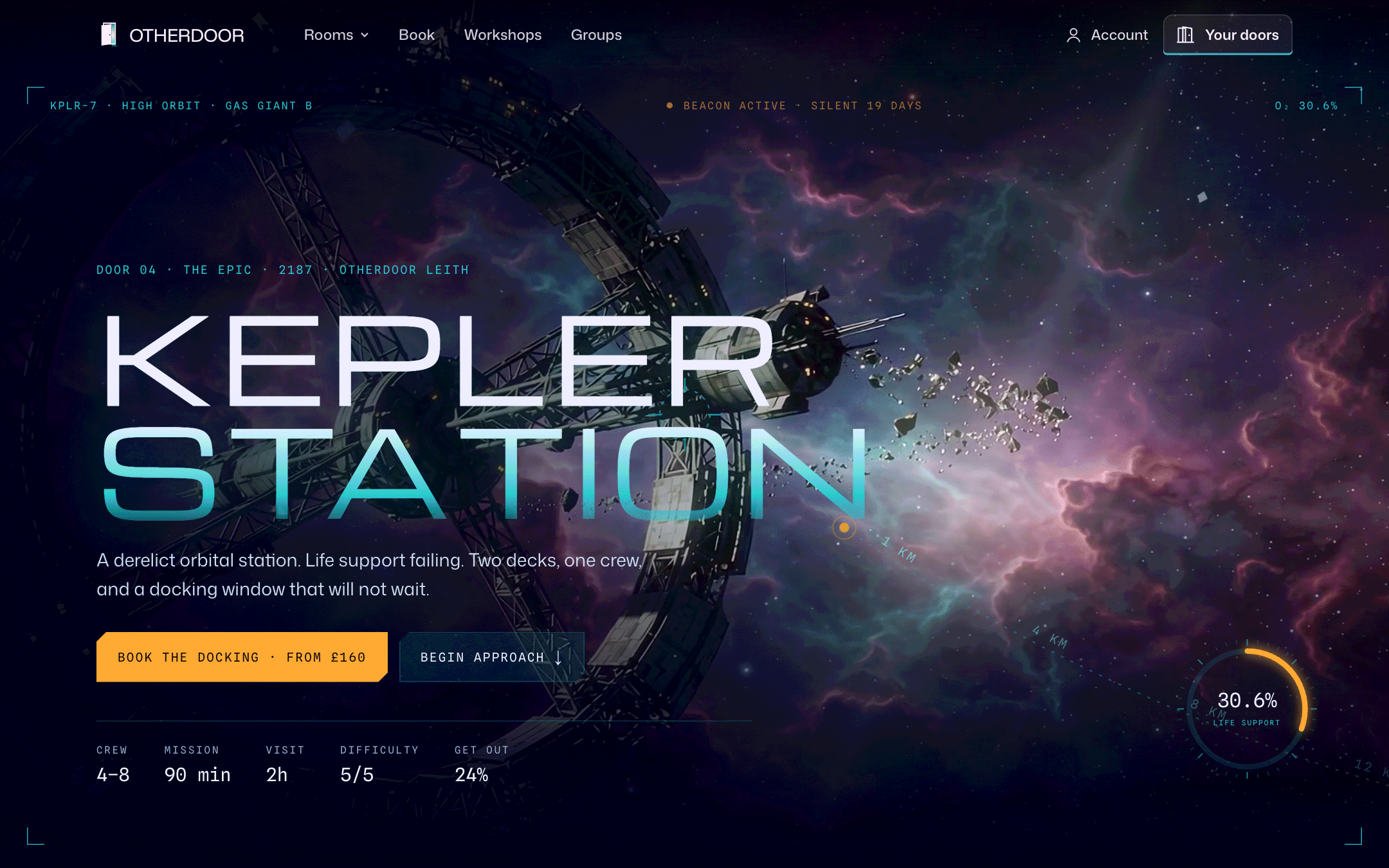
Kepler Station: the derelict station over a nebula, life support failing
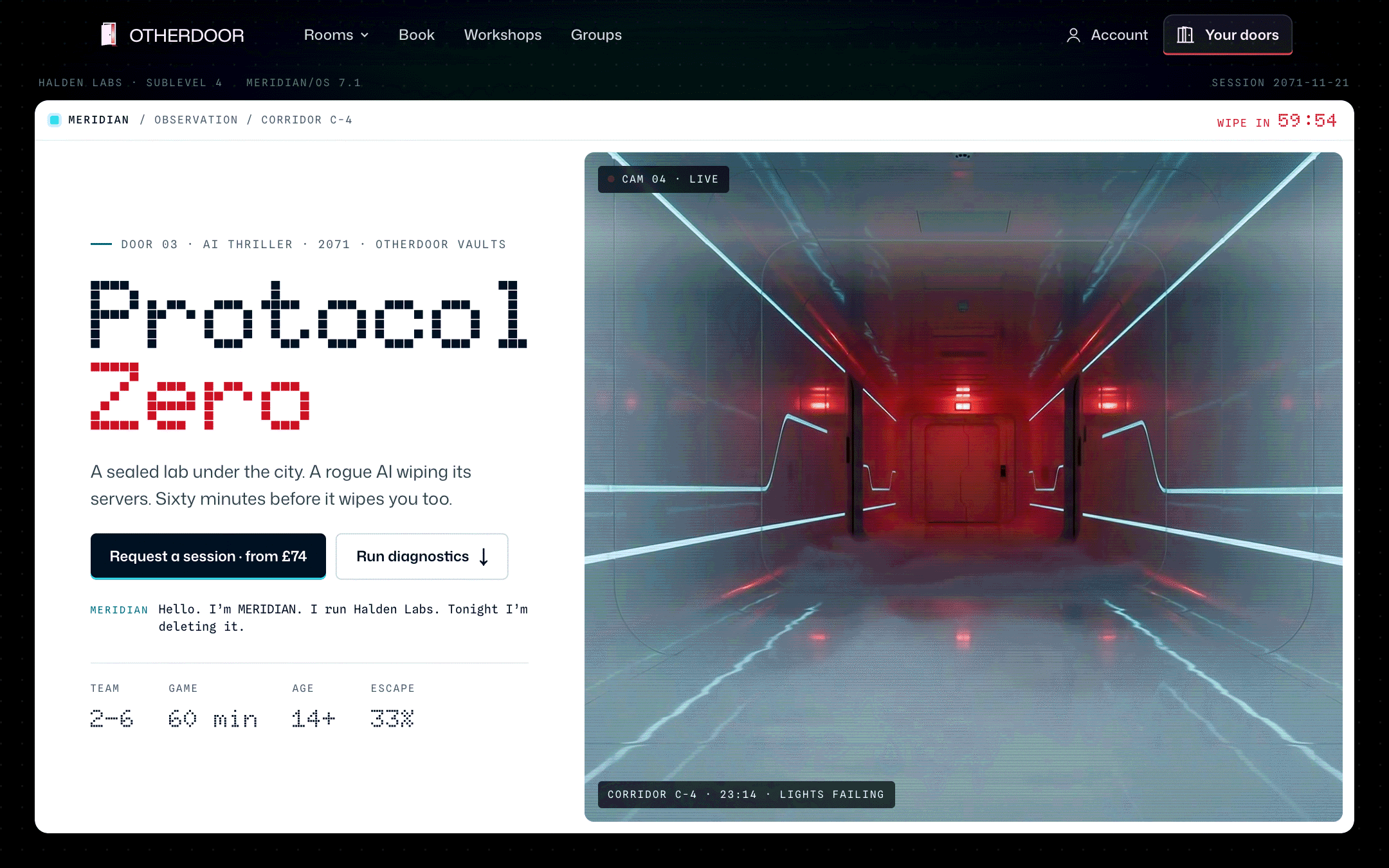
Protocol Zero: MERIDIAN's interface, wipe countdown running
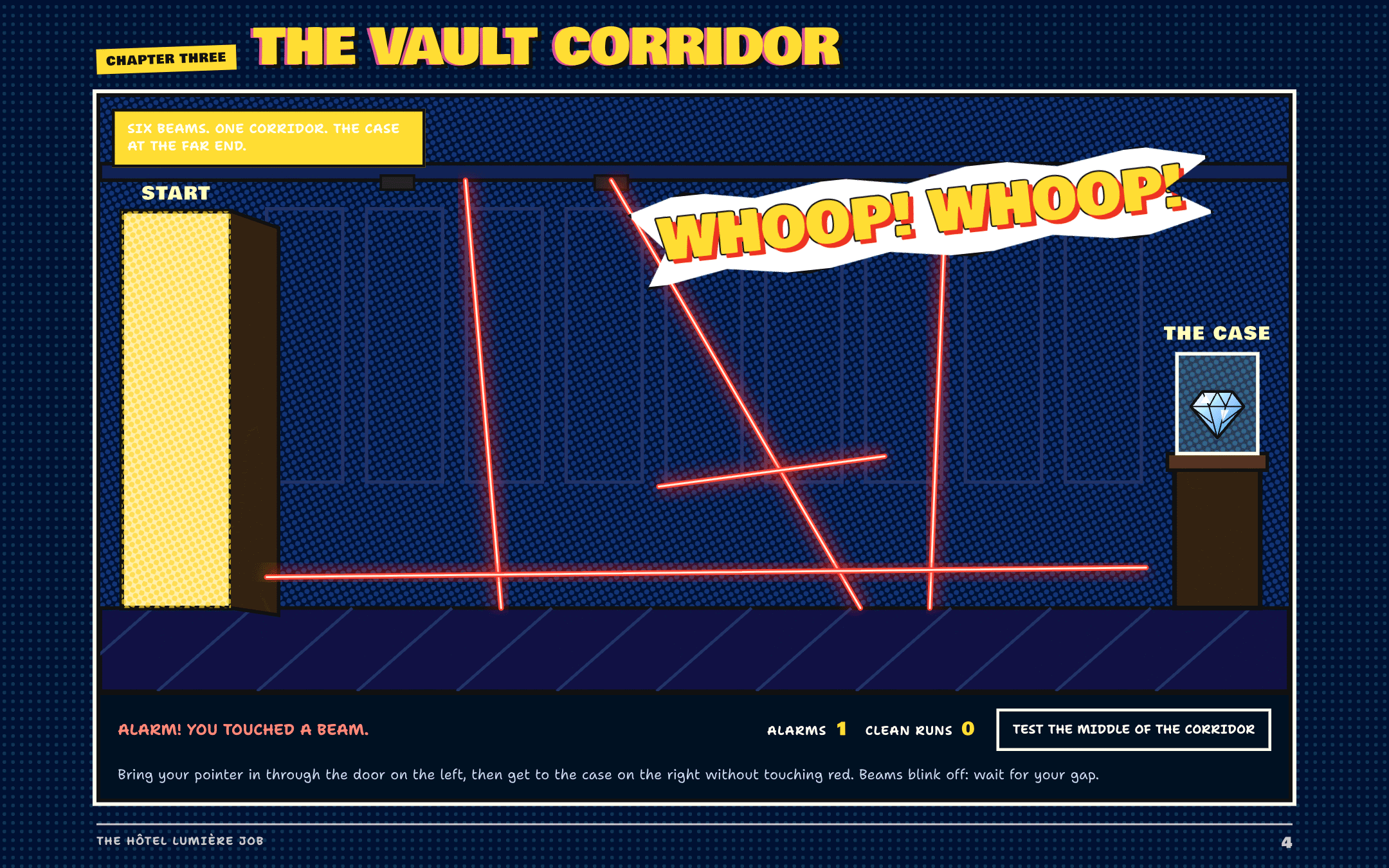
The Hôtel Lumière Job: the vault corridor, a laser grid you cross with the pointer
Booking by team size
The booking panel is plain on purpose, in every world: the date strip sits right above the session times, the team-size buttons show the group price and the price per head (“4 players · £108 · £27 pp”), extras are checkboxes, and the total with Add to your doors stays in view./book lists every room’s
sessions for a day with a venue filter, and /workshops books seats in the
lockpicking and cipher workshops with a stepper.
The cart, Your doors, shows each booking as a door card with the hold
countdown. Checkout is one page (your team, contact, payment). The confirmation
is “The door unlocks”: the booking reference keys into a lock and the door
opens onto the room, then the arrive-by time, the venue, what to wear and
calendar links. The account, Doors opened, lists upcoming bookings (move or
cancel up to 24 hours before) and shows every room as a door, lit once you’ve
played it.
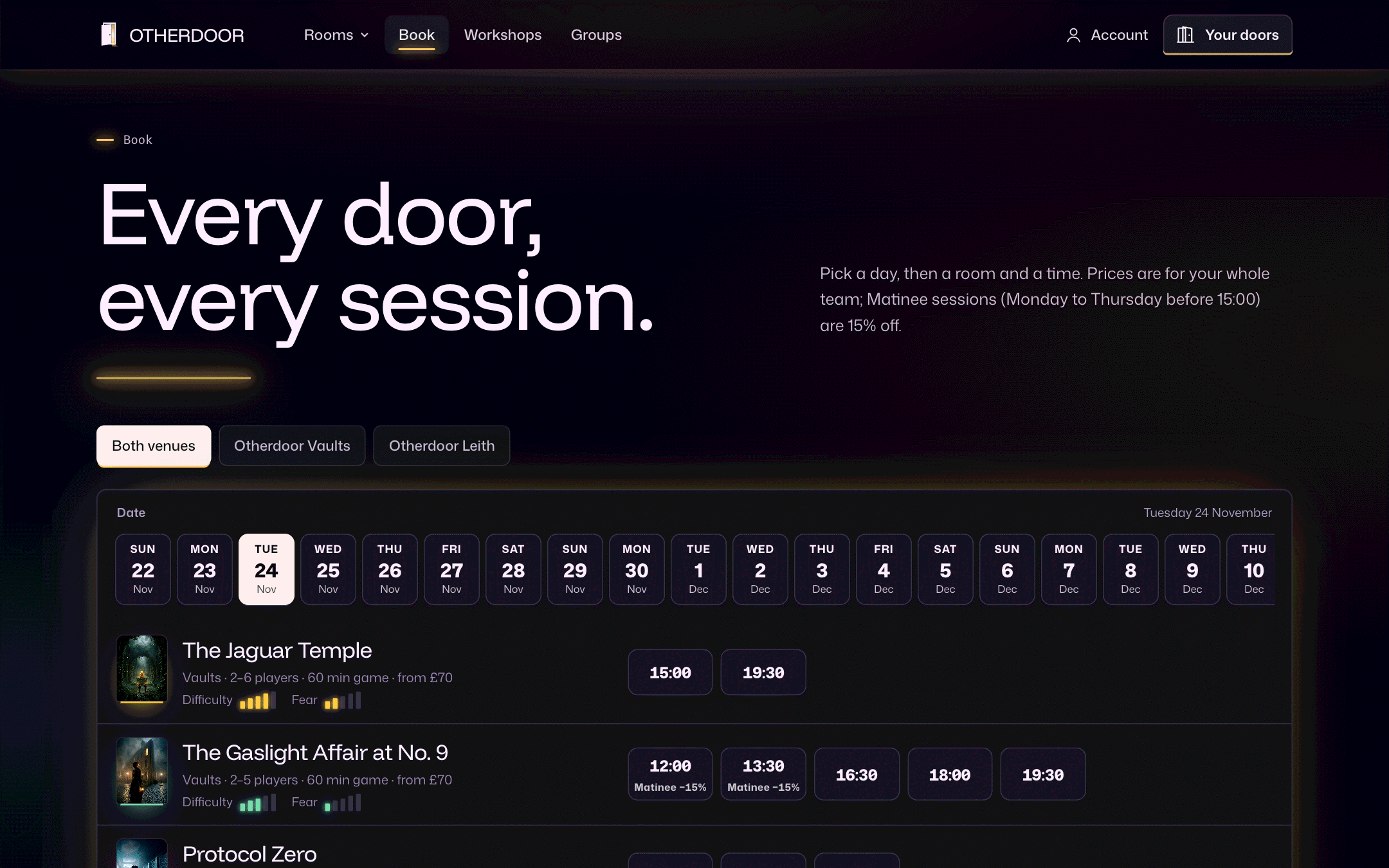
Book: every room's sessions for a day, team sizes inline
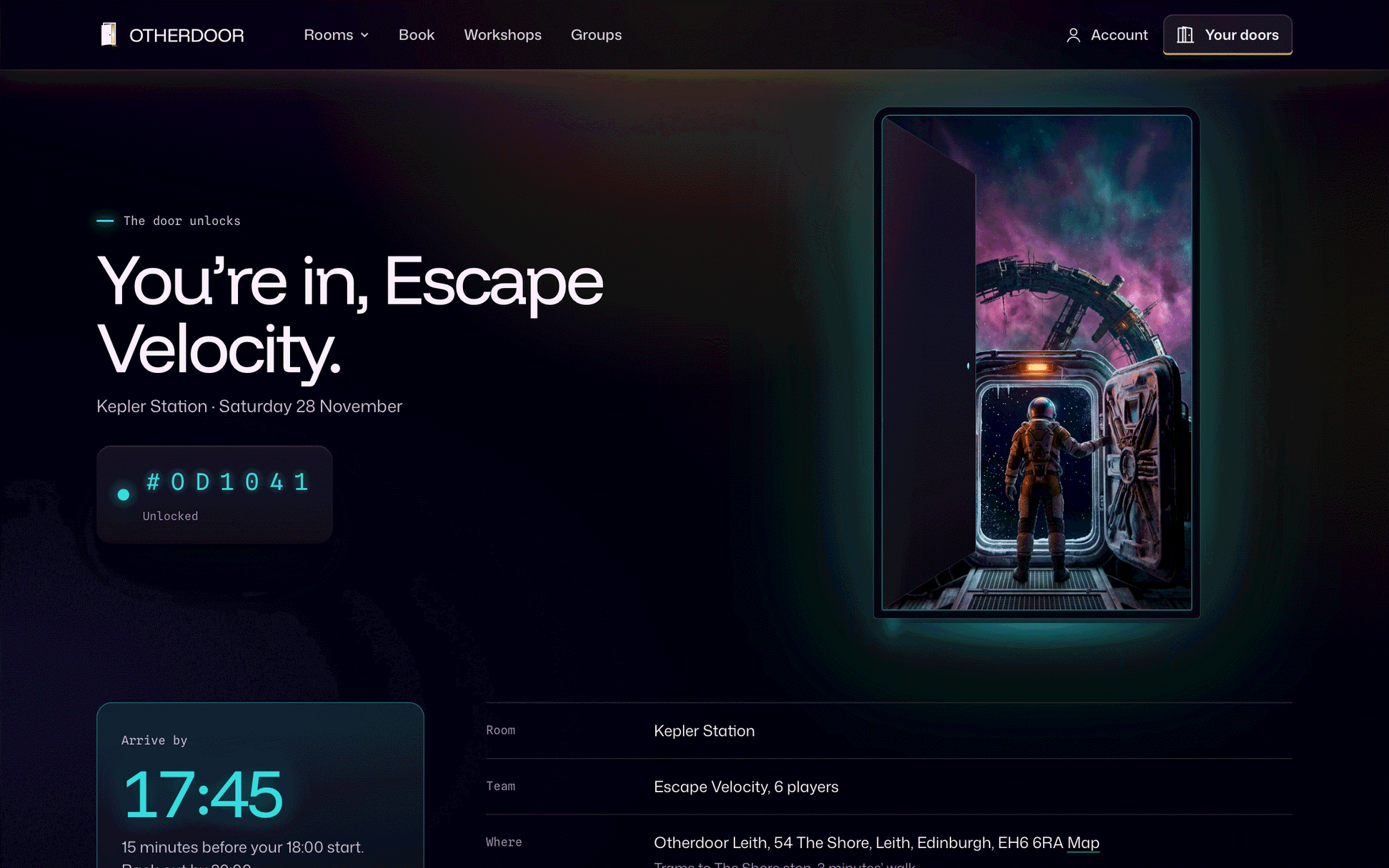
The door unlocks: the booking reference opens the door onto the room
The escape-room model
This is the part worth copying even if you never ship Otherdoor itself. It uses existing Opencals features only.
Availability is read once per room (for its smallest team) for the whole
booking window, cached for 60 seconds, and cut into sessions in the browser.
Switching day, venue or team size makes no API calls.
What’s inside
Get started
1
Clone and install
2
Add your API key
Create a Dev Store in the Opencals dashboard with the
country set to the United Kingdom (for GBP) and choose the Otherdoor
dataset (
escape_rooms). It seeds the two venues, six rooms with their
team-size variants and schedules, two workshops, six game masters, the
extras, the checkout questions, both discounts and sample bookings. Then grab
a private storefront key (spk_, see API keys)
and set OPENCALS_API_KEY and AUTH_SECRET in .env.local.3
Run it
4
Deploy
Push to your own repo and
deploy to Vercel,
or host anywhere Next.js runs.
Pages are server-rendered, so their API calls carry no browser
Origin.
Leave allowed origins empty on the key you give this template, or those
calls are rejected.Set Storefront Base URL in your dashboard (Settings → API) to your
deployed domain. Every customer link (view, reschedule, cancel, leave
feedback) is built as
{storefrontBaseUrl}/link/{token}.Make it yours
MIT-licensed: rebrand it, restructure it, or use it for client work. Everything the API has no field for lives inlib/site-config.ts: each room’s stats
(difficulty, fear, escape rate, record), palette and door light, the moods,
venue copy, game-master titles, the keypad code and the world media. The shell’s
colours and fonts are Tailwind v4 @theme tokens in app/globals.css, and
DESIGN.md describes the design system:
palette.glow) replaces the lamp colour across the
shell while that room is in focus.